How Long Does IVF Abroad Take? Full Cycle, Overseas Stay, and Pregnancy Test Timeline
A complete IVF cycle abroad usually takes about 3 to 6 weeks, while the actual overseas stay varies depending on whether patients use their own eggs or donor eggs and undergo fresh or frozen embryo transfer. This article outlines remote testing, ovarian stimulation monitoring, egg retrieval and transfer, return travel and pregnancy testing, and factors that may cause delays to help patients plan their trip appropriately.
The UK NHS describes a complete cycle as taking about 3–6 weeks. [1] Industry estimates from commercial clinics and assisted reproduction platforms indicate that some cross-border treatment plans may reduce the overseas stay to about 7–14 days. [2] [3]
This article specifically answers:
- How many weeks should usually be allowed for IVF abroad, from the initial consultation through pregnancy testing?
- How long do patients need to stay abroad for treatment using their own eggs, donor eggs, fresh embryo transfer, or frozen embryo transfer?
- Which tests can be completed in the United States, the United Kingdom, Australia, the United Arab Emirates, or Singapore?
- How should egg retrieval, embryo transfer, return travel, and pregnancy testing be coordinated?
- Which medical, legal, and coordination-related factors are most likely to cause delays?
First, Distinguish Between Two Answers: A Complete Cycle Takes About 3–6 Weeks, While the Overseas Stay Is Usually Shorter
When searching for “ivf abroad how long does it take,” there are actually two time periods to calculate: first, the full duration from the initial consultation and testing through pregnancy testing; and second, the number of days the patient must physically be at the destination. These cannot be summarized with the same figure.
The UK NHS describes one complete IVF cycle as taking about 3–6 weeks, including medication, egg retrieval, fertilization, embryo culture, and transfer. This figure can serve as a basic reference for the medical cycle, but cross-border patients must also account separately for appointments, medical-record reviews, visas, and flight connections. [1]
Australian commercial medical information provides a broader industry estimate: most cycles take about 4–8 weeks, including approximately 1–2 weeks for preliminary testing, 1–3 weeks for treatment coordination, and 10–14 days for ovarian stimulation and monitoring. This is a commercial provider’s summary of a typical process, not a guaranteed timeframe applicable to every patient. [4]
A Norwegian clinic’s industry estimate for cross-border patients is approximately 6–8 weeks from consultation to pregnancy testing, with a local stay of about 10–14 days. Under this model, video consultations, some blood tests, and preliminary preparations are completed in the patient’s country of residence. [3]
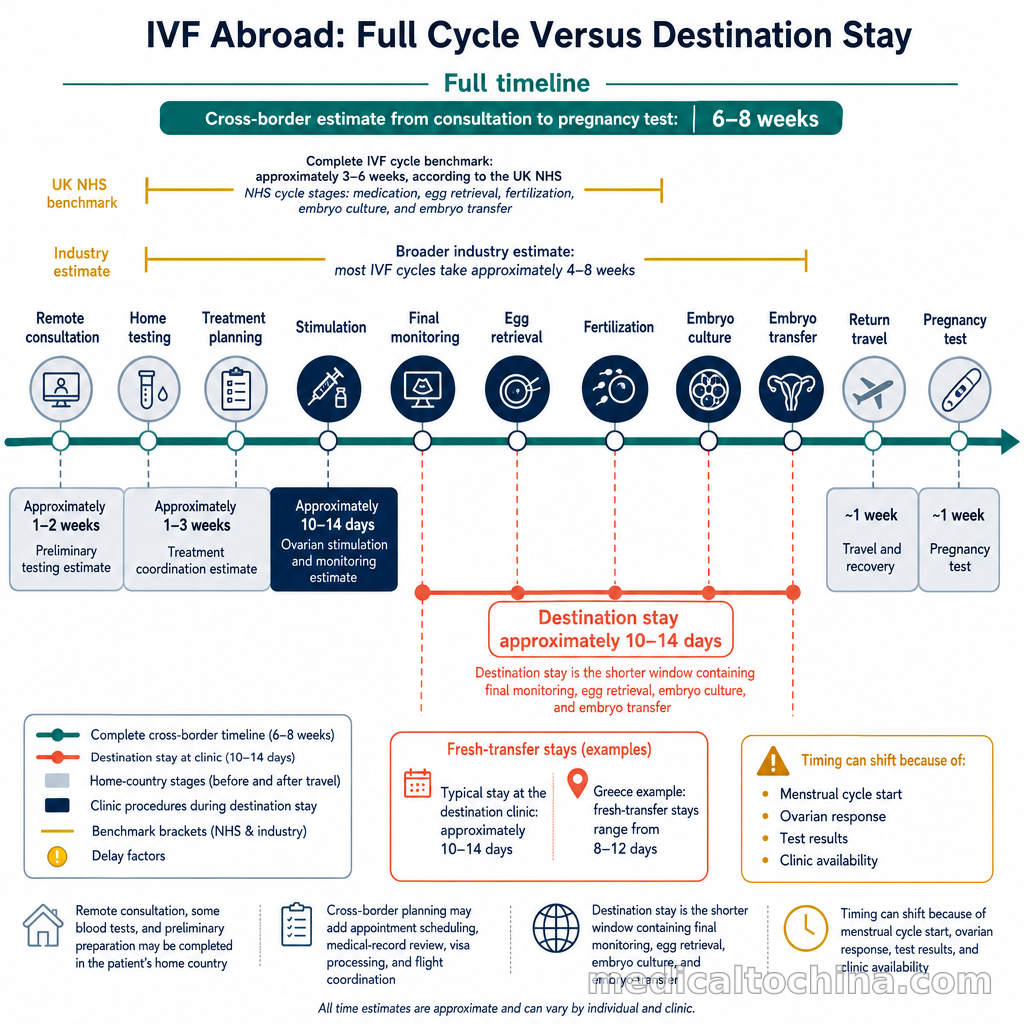
These commercial sources illustrate how cross-border treatment may be organized, but they cannot predict an individual patient’s dates. The start of menstruation, ovarian response to medication, test results, and clinic scheduling may all change the departure date and egg retrieval date. [3] [5] [4]
Patients from the United States, the United Kingdom, Australia, the United Arab Emirates, or Singapore should request both a “complete medical timeline” and a list of the “dates when they must be abroad.” Leave and flights should be arranged around the latter, while the former should be used to plan testing, medication, and pregnancy testing.
Own Eggs, Donor Eggs, Fresh Embryos, and Frozen Embryos Determine How Many Days You Need to Stay Abroad
The length of the overseas stay depends first on whether the patient must personally undergo ovarian stimulation and egg retrieval, and second on whether a fresh embryo transfer will be performed immediately after retrieval or the embryos will first be frozen and transferred in a later cycle.
| Treatment pathway | Industry estimate for overseas stay | Trip structure | Type of source |
|---|---|---|---|
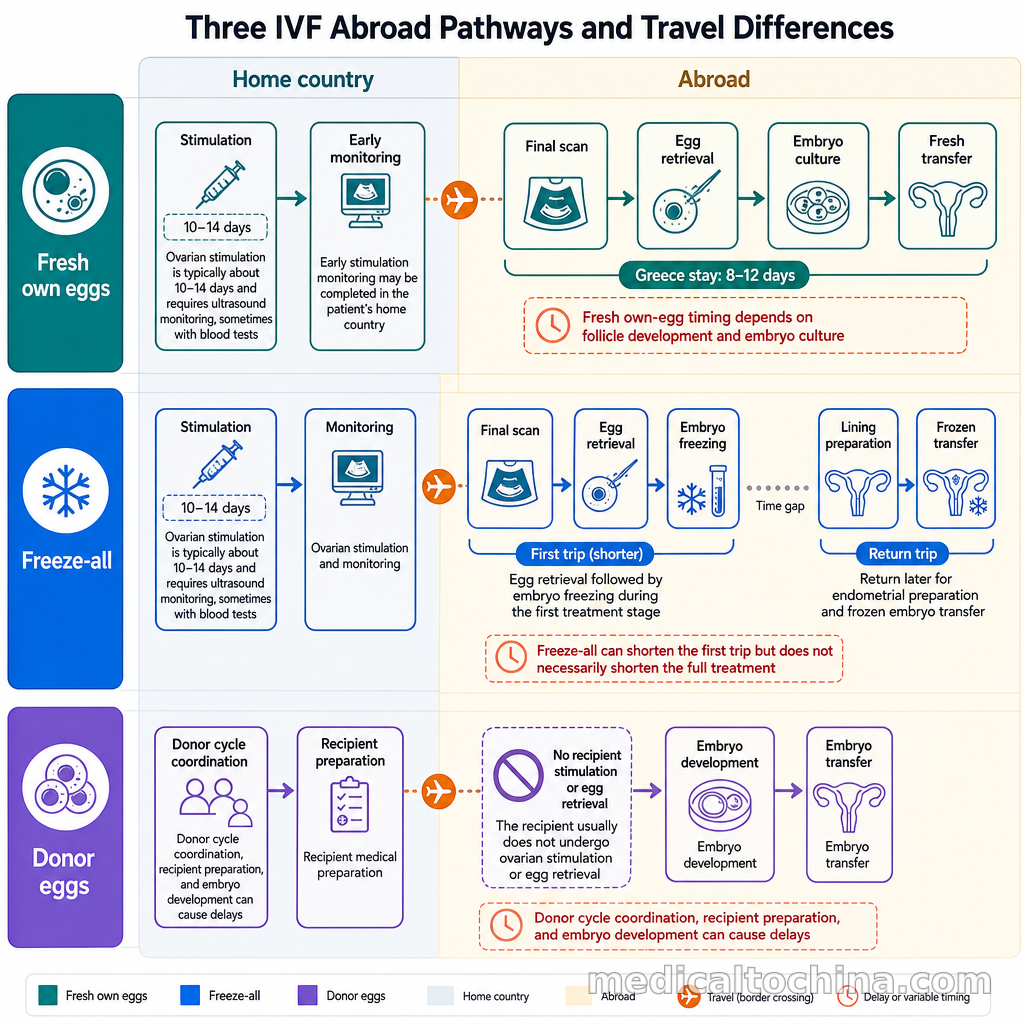
| Own eggs+fresh embryo transfer | About 7–10 days; 8–12 days in a Greek example | Final monitoring, egg retrieval, culture, and transfer are usually concentrated within one trip | Industry estimates from commercial sources [2] [6] [5] |
| Own eggs+freeze-all embryos | About 4–6 days for the first trip | Eggs are retrieved and the embryos frozen during this trip, with frozen embryo transfer scheduled separately afterward | Industry estimate from a Greek clinic example [5] |
| Donor-egg IVF | About 2–3 days to 4–7 days | After completing medical preparation, the recipient travels abroad for the transfer | Industry estimates from multiple commercial sources [2] [7] [6] [5] |
For fresh embryo treatment using the patient’s own eggs, some clinics allow early stimulation monitoring to be completed in the country of residence before the patient travels to the destination for the final scans, egg retrieval, and embryo transfer. Information from a Greek clinic estimates a local stay of 8–12 days under this model, although the exact dates still depend on follicular development and embryo culture. [5]
A freeze-all approach can shorten the first trip, but it does not mean that the entire treatment will be completed sooner. It separates egg retrieval and embryo transfer into two stages, and the patient must still undergo endometrial preparation and frozen embryo transfer later. [5]
Donor-egg treatment usually does not require the recipient to undergo ovarian stimulation or egg retrieval, so fewer days abroad may be needed. However, coordination of the donor’s cycle, the recipient’s medical preparation, and embryo development may still cause delays. [5]
Because patients from the United States and Australia face longer flights, they should not compare plans solely by the number of nights required for a single stay. They should also calculate the airfare, leave requirements, and postoperative arrangements for “one longer stay” versus “two shorter trips.” Patients from the United Kingdom, the United Arab Emirates, and Singapore must likewise account for local monitoring, visas, and the possibility of a second trip for transfer.
A Practical IVF Abroad Timeline: What Can Be Done at Home and What Requires International Travel
Stage 1: Remote Consultation and Testing
The initial consultation can be conducted by video. Common preliminary steps include a medical-history assessment, blood tests, pelvic ultrasound, and semen analysis where applicable. Patients should confirm in advance whether the overseas clinic will accept local reports and what format those reports must use. [3] [4]
The NHS states that blood tests for HIV, hepatitis B, and hepatitis C may be required before IVF begins, and that the treatment consent process must also be completed. [1]
Stage 2: Start of Menstruation, Ovarian Stimulation, and Monitoring
Patients usually begin treatment on a date confirmed by the clinic after menstruation starts. Commercial sources estimate that ovarian stimulation takes about 10–14 days, during which ultrasound monitoring, and sometimes blood testing, is required. [3] [5] [4]
If a doctor in the country of residence can perform monitoring according to the overseas clinic’s requirements, the patient may be able to depart later. One Greek clinic model schedules monitoring at approximately days 5, 7, and 9 of stimulation, but this is only an operational example from a specific clinic, not a fixed rule applicable to every patient. [5]
Stage 3: International Travel, Final Monitoring, and Egg Retrieval
The final departure date often cannot be confirmed until follicular monitoring results are available. Ovarian response may be faster or slower than expected, and the egg retrieval date will be adjusted accordingly. For this reason, fully non-changeable round-trip tickets are not advisable. [5] [4]
After egg retrieval, the eggs enter the fertilization and embryo-culture stage. Whether a fresh embryo transfer is performed, and the specific day on which it occurs, depend on embryo development and the clinic’s protocol. [3] [5]
Stage 4: Embryo Transfer, Return Travel, and Follow-Up in the Country of Residence
The return date should not be based solely on a fixed online template. It should be confirmed by the treatment team in light of the specific procedure and the patient’s condition. Peer-reviewed research has examined the relationship between flying after embryo transfer and IVF outcomes, but it cannot be used to establish a universal rule that all patients “must wait a certain number of days after transfer.” Individual return-travel advice should still be provided by the treating team. [8]
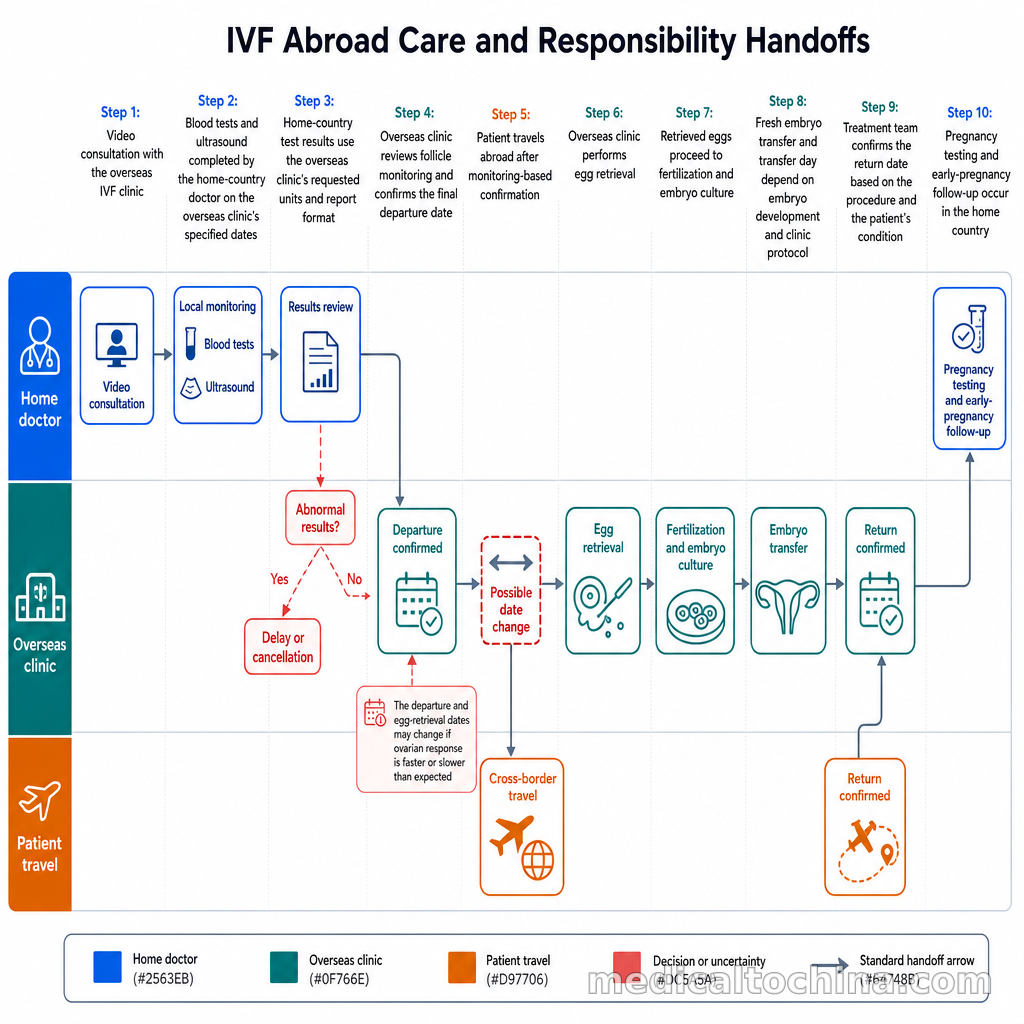
Before departure, patients should confirm whether their doctor in the country of residence can perform testing on the dates, using the units of measurement, and in the report format specified by the overseas clinic. It should also be documented which party will interpret abnormal results and whether an abnormality could delay or cancel the cycle.
Differences Between Countries Involve More Than Flight Time: China Currently Lacks Directly Applicable Data on the Duration of IVF for International Patients
The available European commercial information reflects the organizational models of different clinics, not uniform national standards:
- A Norwegian clinic’s industry estimate is approximately 6–8 weeks from consultation to pregnancy testing, with about 10–14 days spent locally. [3]
- A Greek clinic example estimates a local stay of about 8–12 days for fresh embryo treatment using the patient’s own eggs; the first trip for a freeze-all approach or a donor-egg treatment plan takes about 4–6 days. [5]
- An assisted reproduction information platform estimates a typical overseas IVF protocol at about 17 days and suggests that a trip for donor-egg embryo transfer may be shorter. [7]
These figures cannot be used directly to rank countries or clinics. Some are calculated from the initial consultation, some include only the medication and egg retrieval cycle, and others count only the days the patient actually stays at the destination. [3] [7] [5]
Limits of the Evidence for China
The research materials currently available do not include up-to-date, IVF-specific evidence concerning international patients traveling to China for treatment. It is therefore not possible to verify eligibility requirements, applicable treatment methods, appointment waiting periods, the length of a complete cycle, or the number of days patients must stay in China. Accordingly, this article does not include China in the duration comparisons above and does not provide speculative dates for IVF treatment in China.
Internal information from medicaltochina.com mentions that some general medical procedures in China may be arranged relatively quickly. However, this is not IVF-specific data and does not cover eligibility for assisted reproduction or cycle management, so it cannot be extrapolated into an IVF waiting time for international patients traveling to China. [9]
Before choosing any destination, patients should verify whether local regulations and clinic policies permit treatment for their family structure and intended treatment method. They should also ask the clinic to confirm in writing the waiting period, expected travel dates, and procedures to be followed if a cycle is canceled. Regulatory systems may differ from those in the patient’s country of residence, and information provided by commercial platforms cannot replace official documents from clinics and regulatory authorities. [1] [2]
Before Booking Travel, Ask the Overseas Clinic for This Date-Specific Treatment Plan
Do not accept a vague statement that “two weeks will be needed.” At a minimum, the clinic’s written plan should specify:
- The date on which the initial consultation and medical-record review will be completed;
- The required preliminary tests, report formats, and validity periods;
- The menstrual cycle in which medication is expected to begin;
- The time window for each stimulation ultrasound and blood test;
- The earliest and latest departure dates;
- The expected egg retrieval date, embryo-culture arrangements, and decision point for fresh embryo transfer or a freeze-all approach;
- The earliest possible return date and overseas contact channels if symptoms occur;
- Arrangements for pregnancy testing, continued medication, and early-pregnancy ultrasound after returning home. [1] [10] [5]
The timeline should also include a buffer. Ovarian response to stimulation medication may be faster or slower than average, and the final egg retrieval date may be adjusted accordingly. [5]
The transfer date is not the end of the cycle. Guy’s and St Thomas’ instructs patients to take a pregnancy test on day 16 after egg retrieval. The institution explains that components of the trigger injection can remain in the blood for 8–10 days, and testing too early may produce a false-positive result. Even if bleeding has already occurred, patients should still test on the specified date and report the result. [10]
If the pregnancy test is positive, the institution usually arranges an ultrasound at approximately 7 weeks of pregnancy to assess how the pregnancy is progressing. Before departure, patients should determine whether the overseas clinic will remain responsible remotely during this stage or whether a doctor in the country of residence will take over. [10]
Flights and accommodation should preferably be changeable. Before making payment, patients should confirm refund and rescheduling terms in the event of cycle cancellation, postponement, an unplanned freeze-all approach, or the need for a second trip. [5]
If China is among the destinations under consideration, the next step is not to infer an IVF schedule from the speed of general medical appointments. Instead, patients should first obtain a statement from the hospital regarding international-patient eligibility and a written treatment pathway. medicaltochina.com is a medical coordination platform rather than a hospital. It can assist with requesting and translating relevant documents from Chinese hospitals so that plans in different countries can be compared item by item; eligibility, the treatment plan, and specific dates must still be based on the hospital’s written confirmation and a physician’s assessment.
References
- IVF — nhs.uk
- Fertility Tourism—Top Destinations and Process — fertilityclinicsabroad.com
- How IVF Abroad Works Step by Step | The Process in Norway — klinikkhausken.co.uk
- How Long Does IVF Take from Start to Finish? — dralicehuang.com.au
- Guiding European Patients Through IVF: Key Milestones and ... — newlife-ivf.co.uk
- How Long Do I Need to Be Away from Home for Fertility ... — yourivfabroad.co.uk
- How Long Does IVF Abroad Take? — invitra.com
- Does Flying After Embryo Transfer Affect Implantation?—PMC — pmc.ncbi.nlm.nih.gov
- medicaltochina.com Cost Guide & Why China Reference Data — medicaltochina.com
- IVF Treatment—Results of Your Pregnancy Test — guysandstthomas.nhs.uk
Ready to start your health journey?
Our medical concierge team is available around the clock to answer your questions and help plan your treatment.