Where Is the Best Place for Knee Replacement Abroad? A Guide to Comparing Costs, Rehabilitation, and Safety
Compare reference costs for knee replacement in China, India, Turkey, Poland, Lithuania, Thailand, and South Korea, and learn how to verify the type of surgery, implants, inpatient rehabilitation, complication coverage, and return-flight arrangements—rather than choosing based solely on a low advertised price.
Where Is the Best Place for Knee Replacement Abroad? A Guide to Comparing Costs, Rehabilitation, and Safety
medicaltochina.com reference pricing for top-tier Chinese hospitals indicates that major procedures such as knee replacement have a reference cost of $4,200–14,000+ in China, compared with $19,000–68,000+ in the United States. However, the “best” option cannot be determined from the surgical quote alone: implants, rehabilitation arrangements, complication coverage, and when the patient can fly after surgery can all affect the final choice.[MTC] Peer-reviewed research notes that there is currently no consistent consensus on advice regarding air travel after hip or knee replacement.Source 2
This article specifically answers:
- How do quotes from China, India, Turkey, Poland, Lithuania, Thailand, and South Korea compare?
- Why is the lowest advertised price not necessarily the lowest total treatment cost?
- How should patients verify the surgeon, hospital capabilities, implants, and rehabilitation plan?
- How should patients from the United States, United Kingdom, Australia, the United Arab Emirates, and Singapore evaluate return flights and continuity of care?
- What items must be included when requesting a written quote from an overseas hospital?
Confirm the Type of Surgery First, or Quotes From Different Countries Cannot Be Properly Compared
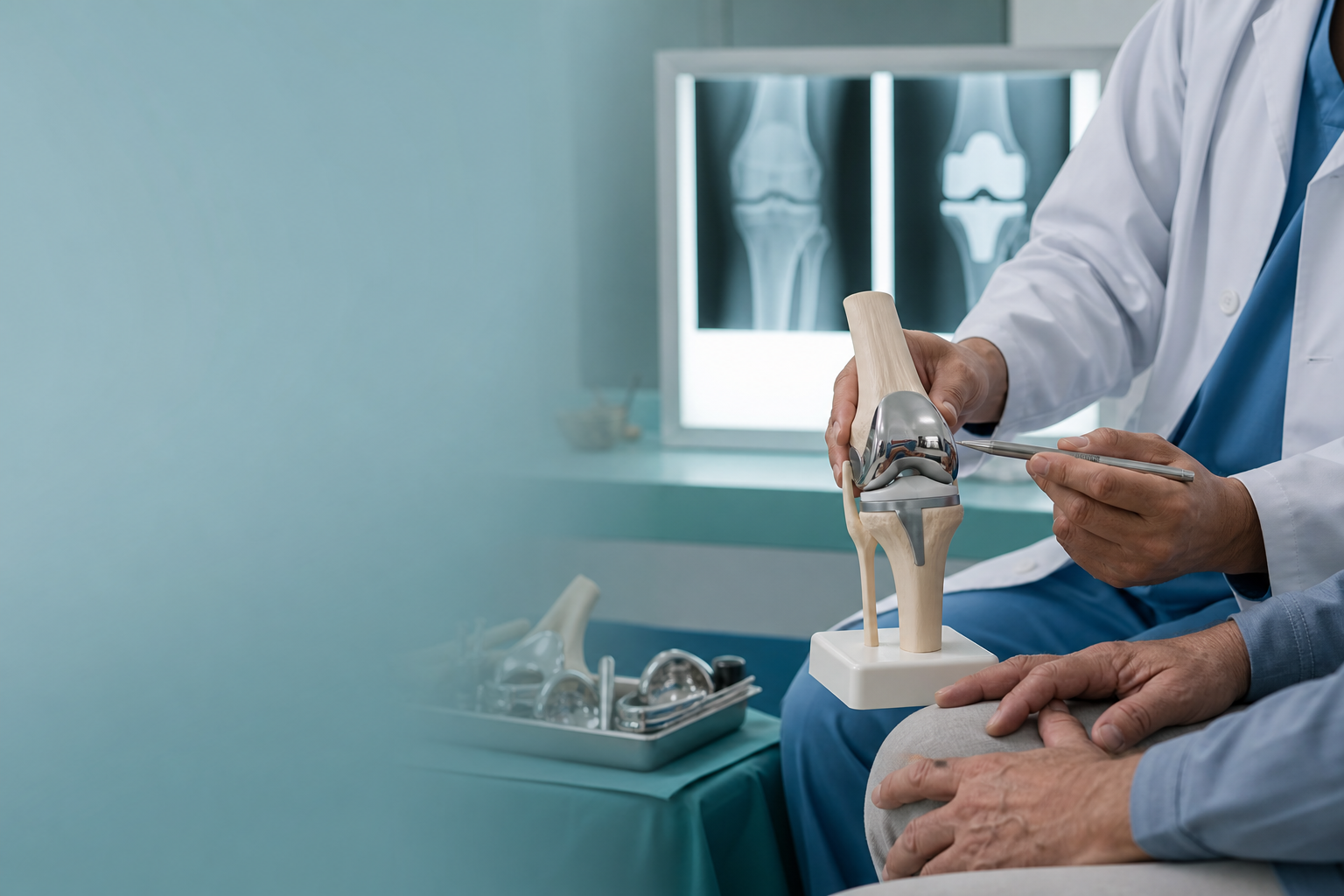
Total knee replacement generally involves removing the damaged portions at the lower end of the femur and upper end of the tibia, then reconstructing the joint surfaces with metal and plastic components. Partial knee replacement treats only the affected side of the knee and may involve a smaller incision and faster recovery.Source 1
The procedure generally takes about 1–2 hours, but the final surgical approach depends on the extent of joint damage, the patient’s age, and overall health.Source 1 Before accepting any price comparison, patients should ask each prospective hospital to confirm in writing:
- Whether the procedure is a total or partial knee replacement;
- Whether it is unilateral or bilateral;
- Whether it is a primary replacement or revision;
- Whether the implant is included in the base price;
- Whether robotic assistance is recommended, and whether it is clinically necessary or an optional charge.Source 1Source 8
Robotic assistance should not be compared merely as a technology label. One provider in Lithuania lists it separately as an add-on costing about £2,085, illustrating how different technical approaches can result in different bills even at the same hospital.Source 8
Complex replacements and revisions are even less suitable for standard primary-replacement packages. The Department of Orthopedic Surgery at West China Hospital, Sichuan University, identifies complex hip and knee replacement, revision surgery, and enhanced recovery in orthopedics as key areas of expertise, indicating that these patients require assessment by a specialized team.Source 11
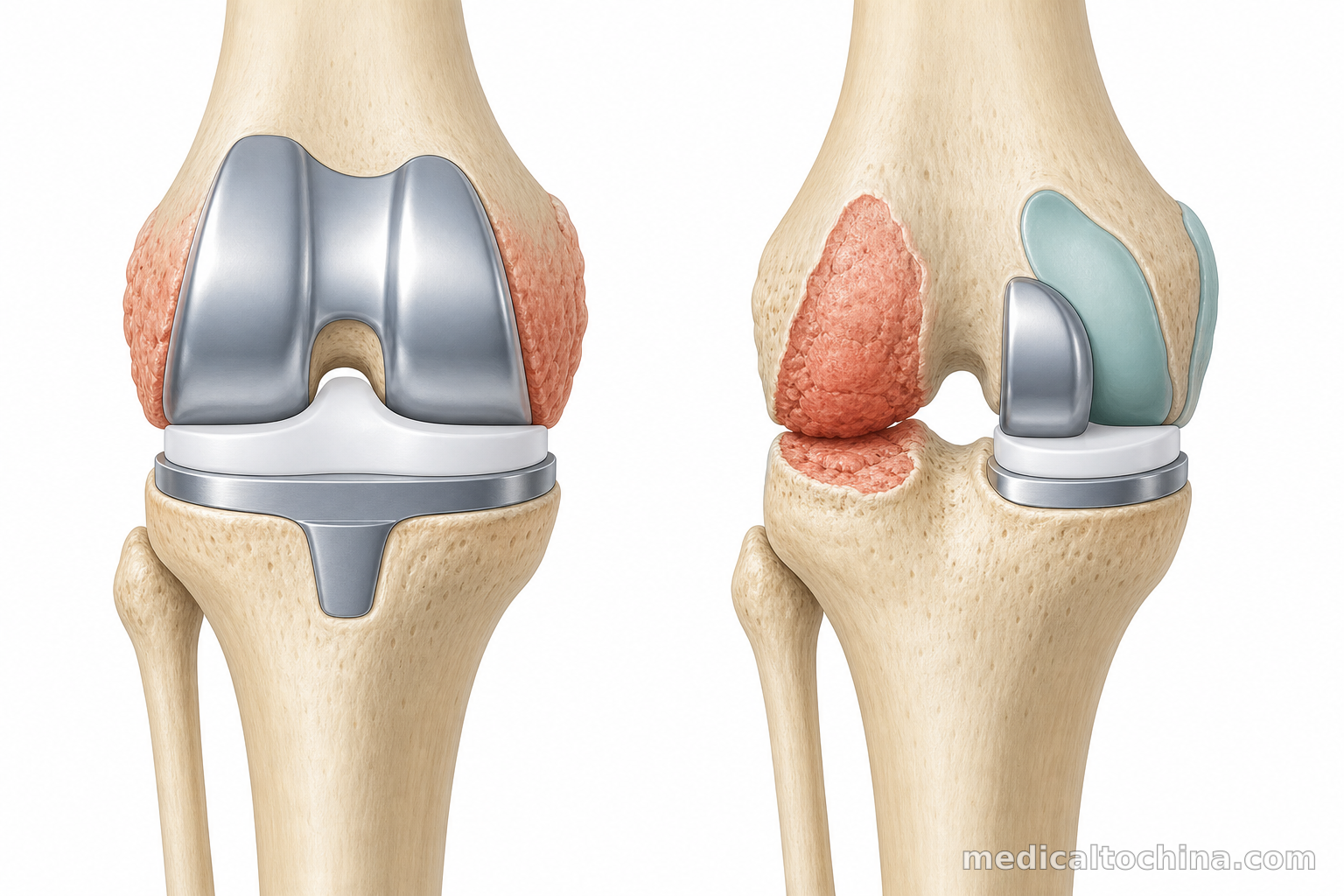
For patients from the United States, United Kingdom, Australia, the United Arab Emirates, and Singapore: Before comparing prices, ask a local physician or the prospective hospital to confirm the type of surgery. Two quotes both labeled “knee replacement package” may cover entirely different surgical scopes, implants, and rehabilitation needs.
Comparing Popular Destinations: Price, Waiting Time, and Clinical Capabilities Belong in the Same Table
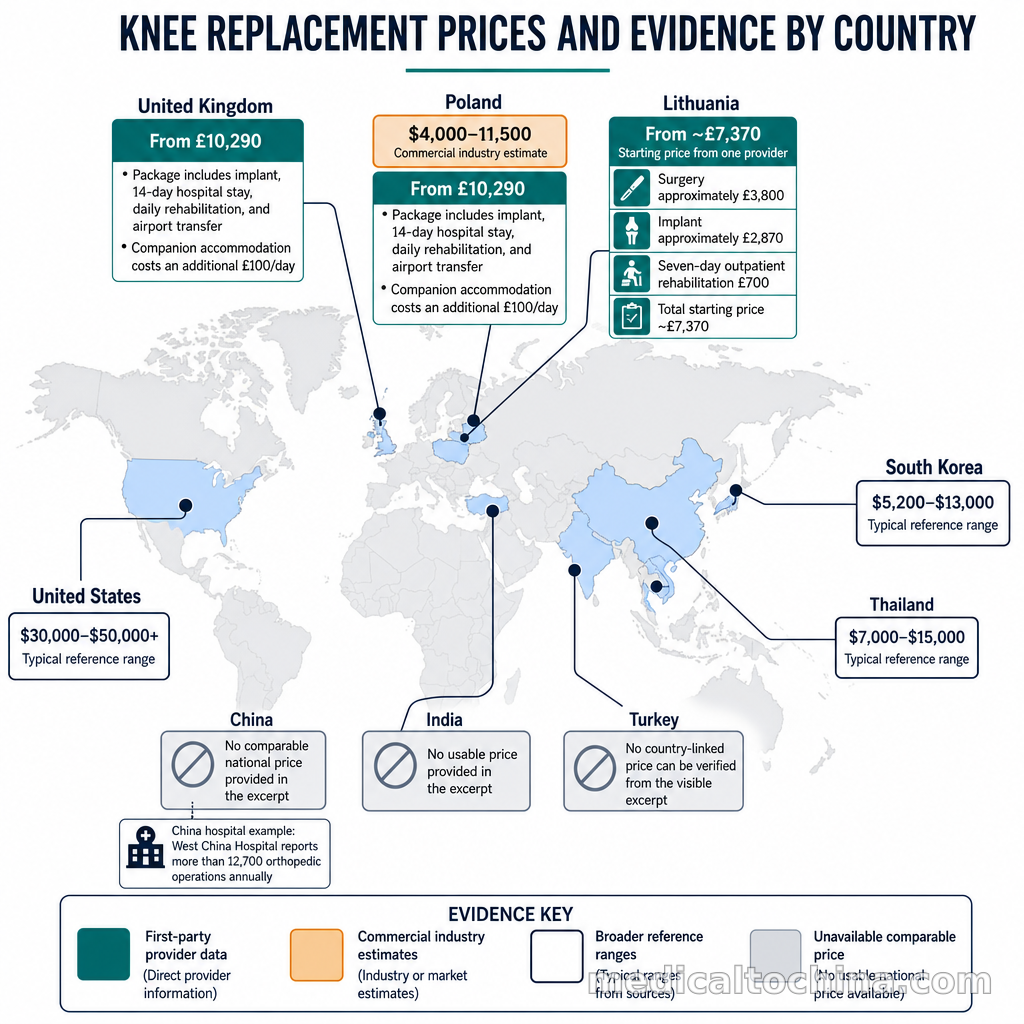
The prices below combine first-party reference data with quotes from commercial organizations, so the levels of evidence are not the same. Commercial sources should be used only as preliminary screening information, not as government pricing, independently audited findings, or guaranteed final prices.
| Destination | Reference treatment price | Nature of quote | Hospital stay, implants, and rehabilitation | Waiting times and international-patient considerations |
|---|---|---|---|---|
| China | $4,200–14,000+ | medicaltochina.com reference pricing for top-tier Chinese hospitals; the hospital’s written quote is final[MTC] | Implants, hospitalization, and rehabilitation must each be confirmed[MTC] | Most procedures can be arranged within one week of arrival, but time must be allowed for medical-record review, visas, and preoperative assessment[MTC] |
| India | $5,000–9,000 | Industry estimate from a medical-tourism coordinatorSource 9 | Package contents must be confirmed by the hospitalSource 9 | The specific hospital, physician, and international-patient services should be verifiedSource 9 |
| Turkey | $3,000–9,000 | Industry estimate from a commercial aggregator platformSource 5 | The platform states that some packages include the implant, hospital stay, hotel, transfers, and tests, but the specific quote must be verifiedSource 5 | Country-level prices listed by a platform cannot replace an assessment by the hospitalSource 5 |
| Poland | $4,000–11,500 | Industry estimate from a commercial aggregator platformSource 5 | One international-patient package starts at £10,290 and includes the implant, 14 days of hospitalization, and daily rehabilitationSource 7 | Package structures vary considerablySource 5Source 7 |
| Lithuania | About £7,370 and up | Published price from a single providerSource 8 | Surgery, the implant, and seven days of outpatient rehabilitation are priced separately; robotic assistance costs extraSource 8 | Length of accommodation and return-travel arrangements must be verified separatelySource 8 |
| Thailand | $6,500–7,500 | Industry estimate from a commercial aggregator platformSource 5 | Package scope cannot be inferred from a national average priceSource 5 | Long-haul return travel must be planned separatelySource 2 |
| South Korea | $7,000–18,000 | Industry estimate from a commercial aggregator platformSource 5 | The extent to which implants and rehabilitation are included must be confirmed in writingSource 5 | Long-haul return travel must be planned separatelySource 2 |
As an example of how to verify a Chinese hospital’s capabilities, West China Hospital reports that its Department of Orthopedic Surgery has six subspecialties, including joint surgery, performs more than 12,700 operations annually, and provides complex hip and knee replacements, revision surgery, and enhanced recovery.Source 11 Hospital-level data of this kind are more useful than broad “country rankings,” but patients should still verify the prospective surgeon’s experience with knee replacement cases. In a Chinese-language healthcare setting, English-language services, medical-record translation, visa coordination, and arrangements for follow-up after returning home should also be confirmed in advance.[MTC]
Patients from the United Kingdom may also compare the Czech Republic, Hungary, Germany, and Turkey. Relevant commercial materials show a wide price range and caution that imaging, extended rehabilitation, and complication management may not be included in the base price. NHS waiting times cited in these materials are also only industry estimates quoted by commercial sources and should not be treated as uniform nationwide data.Source 6
Patients from the United States should compare the complete overseas cost with the US reference range of $19,000–68,000+ on a like-for-like basis; the private-sector reference range in the United Kingdom is $12,700–19,000.[MTC] The available materials are insufficient to calculate reliable savings percentages for patients from Australia, the United Arab Emirates, and Singapore, so domestic hospital or official pricing should be obtained first. Regardless of the departure market, long-haul flights and rehabilitation after returning home should not be removed from the decision table.Source 2
Breaking Down the “All-Inclusive Price”: At Least These Eight Items Must Be Checked to Determine the True Total Cost
Send the same quote-request template to each hospital and ask for at least the following 8 items to be itemized:
- Surgeon and anesthesia fees;
- Implant brand, model, and price;
- Blood tests, X-rays, CT, or MRI;
- Number of hospital days, room category, and medications;
- Number and format of initial physical therapy sessions;
- Additional charges for robotic assistance or other technologies;
- Costs for the hotel, local transportation, interpretation, and accompanying persons;
- Who is responsible for complications, an extended hospital stay, and revision treatment, and how these are charged.Source 6Source 7Source 8Source 10
Package examples illustrate the issue most clearly. One package in Poland starts at £10,290 and includes the implant, 14 days of hospitalization, daily rehabilitation, and airport transfers, but an accompanying person sharing the accommodation costs an additional £100/day.Source 7 A provider in Lithuania lists surgery at about £3,800, the implant at about £2,870, seven days of outpatient rehabilitation at £700, and robotic assistance at about £2,085 as separate items.Source 8
A French package offered by a commercial provider is advertised at £12,490 and lists preoperative testing, the implant, at least three nights in the hospital, ten nights of rehabilitation accommodation, daily physical therapy, and local transportation. Its complication insurance applies only within the terms of the policy, so patients must request the full policy rather than relying solely on the words “insurance included.”Source 10
China’s $4,200–14,000+ range is likewise a reference range, not a guaranteed price. The hospital must still issue a formal quote based on the patient’s medical records, type of surgery, and implant selection.[MTC]
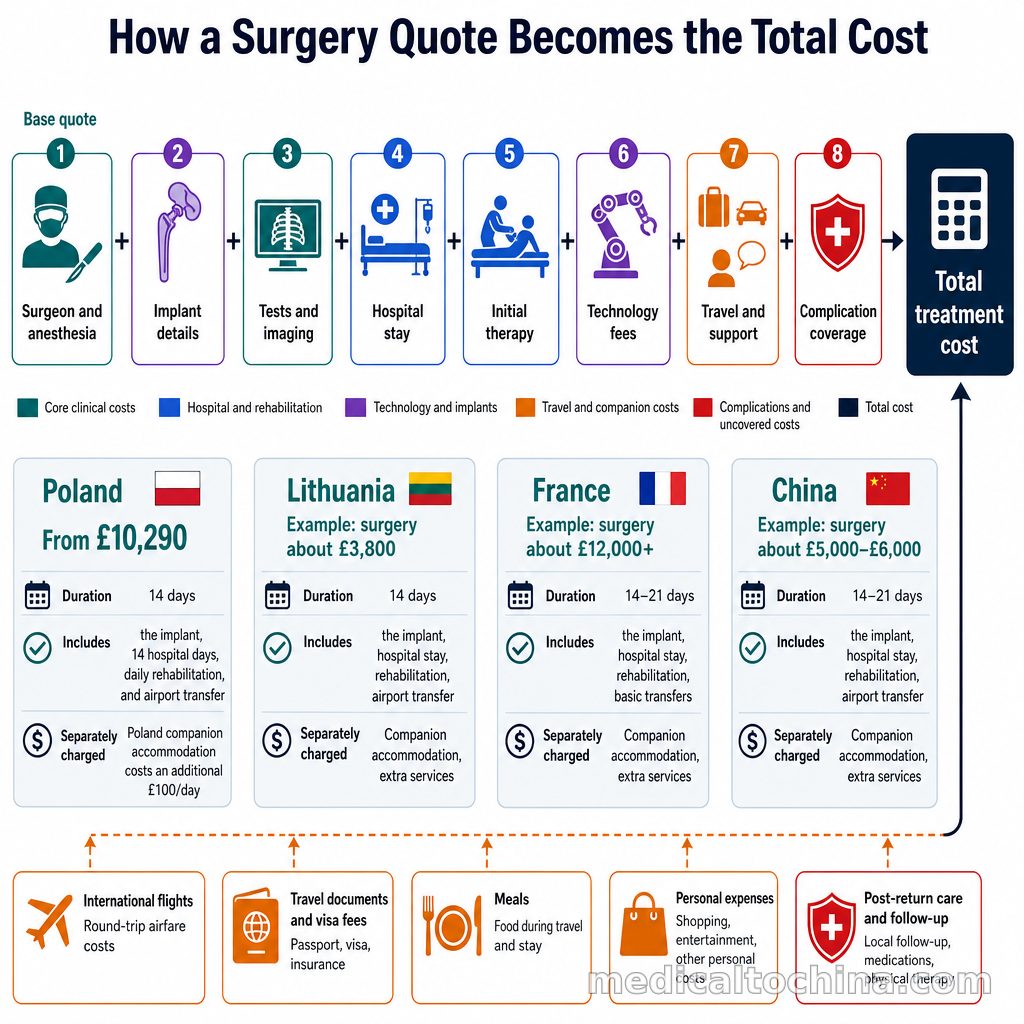
The “maximum savings” promoted by commercial organizations are not necessarily achievable for every individual.Source 5Source 6 For comparison, first standardize the currency, then add airfare, visas, accommodation, accompanying-person costs, an extended stay, and rehabilitation after returning home.Source 6[MTC] For patients from Australia, Singapore, and the United Arab Emirates, flight duration and accommodation for a caregiver may have a particularly significant effect on total cost. The timing of the return journey must be assessed individually by the clinical team.Source 2
“International Accreditation Always Means the Best” Is a Misconception; Continuity of Care Is More Useful for Distinguishing Between Options
Accreditation is suitable as an initial screening criterion, but it cannot replace verification of the specific physician, joint-replacement team, and case experience.Source 5Source 9 Patients can ask the hospital to provide:
- Whether the operating surgeon primarily performs knee replacements and revisions;
- The relevant surgical volumes of both the hospital and the physician;
- The implant brand, model, and method of postoperative tracking;
- The statistical definitions used for infection, thrombosis, readmission, and revision data;
- Whether there is a clearly defined enhanced-recovery and physical therapy pathway;
- Who will manage the wound, pain, reduced range of motion, and abnormal symptoms after discharge.Source 3Source 11
Wound closure is not a minor detail. A Delphi consensus developed by Indian orthopedic experts concluded that wound closure after joint replacement is crucial to recovery and discussed methods including barbed sutures, conventional sutures, skin adhesive, and staples.Source 3 However, this was a consensus produced by 12 experts, not a permanent standard applicable to every patient. The authors also noted that the recommendations should be updated periodically as new evidence emerges.Source 3
There is likewise no simple answer for flight arrangements. Peer-reviewed research found no consistent consensus on advice regarding air travel after hip or knee replacement and recommended that surgeons exercise caution when providing guidance.Source 2 This article therefore does not provide a universal number of days after surgery when it is always safe to fly. The correct approach is to obtain individualized written clearance from the operating surgeon and confirm restrictions with the airline and travel insurer.Source 2
The most important conclusion here is: there is no universal number of days after which a patient is fit to fly.Source 2
If problems with the wound, pain, or mobility arise after the patient returns home, the original surgical team may be in another country. Before departure, patients must determine how the overseas hospital, domestic physician, and physical therapist will exchange operative records, implant information, medication plans, and rehabilitation goals.Source 2Source 3 For patients making long-haul journeys from Asia or Europe back to the United States, Australia, or Singapore, the flight plan may directly affect whether a destination is suitable. Patients from the United Kingdom and the United Arab Emirates should not omit a postoperative fitness-to-fly assessment merely because some routes are shorter.Source 2
The Next Step Is Not Booking a Flight, but Completing an Auditable Cross-Border Comparison Table
First, ask prospective hospitals to use the same medical records to confirm whether the procedure is a total or partial replacement, primary or revision surgery, and which surgical approach they recommend.Source 1Source 11
Second, obtain written, itemized quotes from at least 2—3 hospitals, using the same categories for implants, anesthesia, hospitalization, imaging, medications, rehabilitation, interpretation, transfers, and additional charges.Source 6Source 7Source 8
Third, request the operating surgeon’s credentials and relevant case experience, the hospital’s accreditation, and the postoperative rehabilitation pathway. Country lists, platform rankings, and patient reviews cannot replace these clinical checks.Source 5Source 9Source 11
Fourth, before making payment, obtain individualized plans for the local stay, return flight, and follow-up care after returning home. Existing research does not support applying one flight timeline to every patient.Source 2
Fifth, read the complication terms word for word and confirm who is responsible for an extended hospital stay, additional follow-up visits, repeat surgery, and treatment after the patient returns home.Source 6Source 10
If China is shortlisted, the next step should be to request a formal, itemized estimate from the hospital and align it line by line with quotes from other countries. medicaltochina.com is a medical concierge platform rather than a hospital. It can assist with matching patients to hospitals and specialists, appointments, quote translation, visa and travel arrangements, in-hospital interpretation, and coordination of follow-up after returning home. The platform does not provide medical diagnoses or guarantee prices or treatment outcomes.[MTC]
Sources
- [MTC] medicaltochina.com internal reference data. (First-party reference data)
- Source 1 NHS. How a knee replacement is done. (Government source) https://www.nhs.uk/tests-and-treatments/knee-replacement/how-its-done/
- Source 2 Oputa TJ, et al. Is There a Consensus on Air Travel Following Hip and Knee Arthroplasty? (Peer-reviewed journal) https://pmc.ncbi.nlm.nih.gov/articles/PMC10508977/
- Source 3 Maniar RN, et al. A STRIDE Initiative for Orthopedic Surgeons of India. (Peer-reviewed journal) https://pubmed.ncbi.nlm.nih.gov/38009180/
- Source 5 Bookimed. Where to Get the Best Knee Replacement Surgery Abroad. (Commercial medical-tourism aggregator platform) https://us-uk.bookimed.com/article/the-best-knee-replacement-surgery/
- Source 6 Praga Medica. Cost of Knee Replacement Abroad: UK vs Europe Price Comparison. (Commercial material) https://www.pragamedica.com/blog/news-orthopaedics/knee-replacement-abroad-cost
- Source 7 EuroTreatMed. Knee Replacement Surgery Abroad in Poland. (Commercial provider quote) https://eurotreatmed.co.uk/treatments/orthopaedics/total-knee-replacement/
- Source 8 Nordorthopaedics. Knee Replacement Abroad in Lithuania. (Commercial provider quote) https://www.nordorthopaedics.com/en/knee-replacement-surgery-abroad-lithuania
- Source 9 Emerge Medical Travel. Top 5 Countries for Knee Replacement Surgery in 2026. (Commercial medical-tourism coordinator) https://emergemedicaltravel.com/blogs/top-countries-knee-replacement-surgery-2026/
- Source 10 Elite Surgery Abroad. Knee Replacement Surgery Abroad: France. (Commercial provider quote) https://www.elitesurgeryabroad.com/surgeries-uk/knee-replacement/
- Source 11 West China Hospital, Sichuan University. Orthopedic Surgery. (Hospital source) https://www.wchscu.cn/details/51686.html
Ready to start your health journey?
Our medical concierge team is available around the clock to answer your questions and help plan your treatment.