Where Is the Best Place Abroad for Knee Replacement? A Cost and Safety Comparison for Patients from Five Countries
This article compares knee replacement costs and package inclusions in destinations such as China, India, Turkey, Poland, and Lithuania. It also explains how to calculate implant, hospitalization and rehabilitation, travel, and complication costs on a consistent basis, while verifying the surgical team, postoperative flight risks, and follow-up arrangements after returning home.
Where Is the Best Place Abroad for Knee Replacement? A Cost and Safety Comparison for Patients from Five Countries
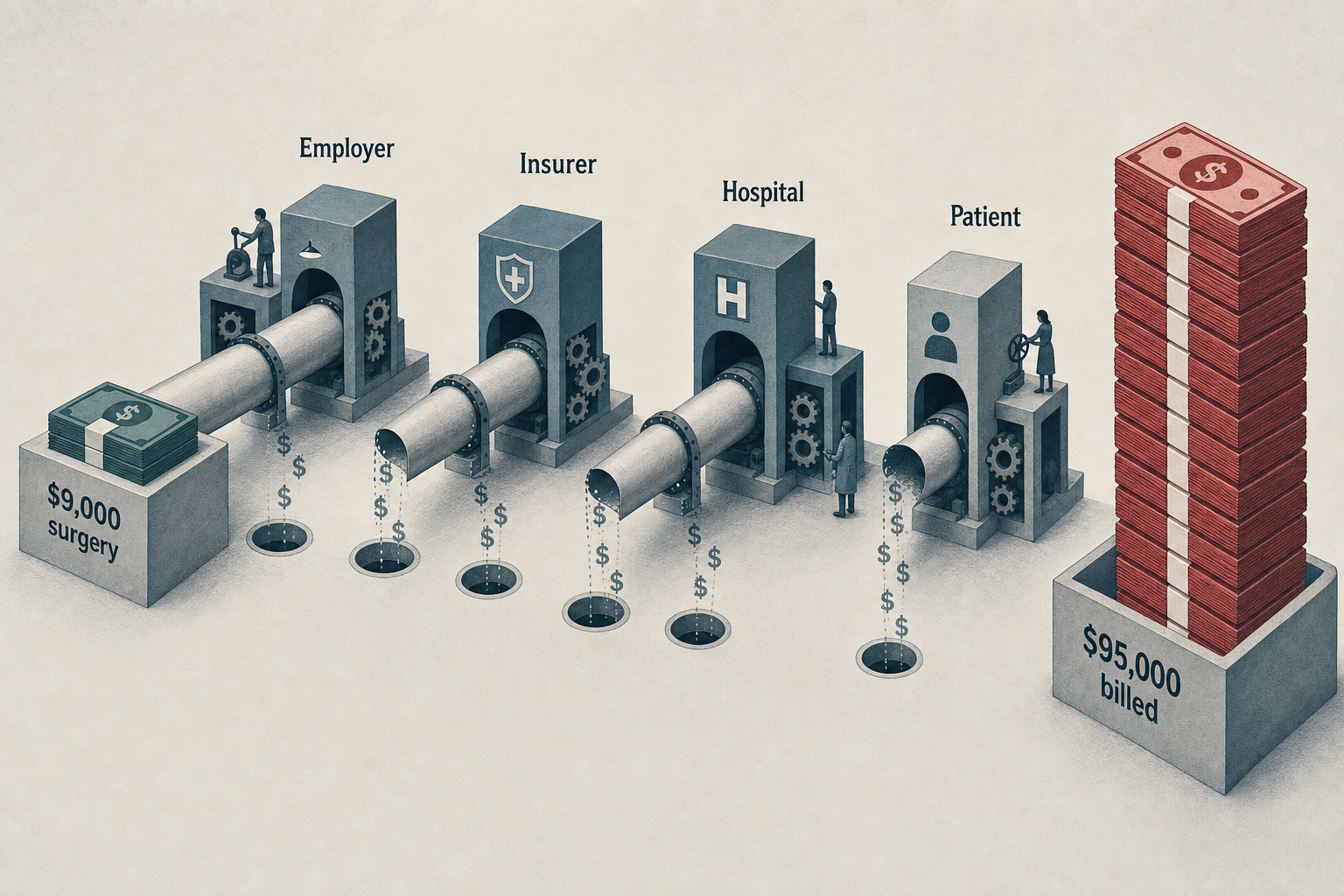
Reference prices from high-level Chinese hospitals listed by medicaltochina.com show that major procedures such as knee replacement cost $4,200–14,000+ in China, compared with a reference list price of $19,000–68,000+ in the United States. This is only a starting point for comparison: the final price depends on the hospital’s written quote, and whether implants, rehabilitation, and complication coverage are included is often more important than the lowest advertised price.[MTC]
This article answers five questions:
- For patients from the United States, United Kingdom, Australia, United Arab Emirates, and Singapore, which overseas destinations are worth shortlisting?
- How do knee replacement costs compare among destinations such as China, India, Turkey, Poland, and Lithuania?
- How can different hospitals’ “package prices” be standardized into an itemized total cost for direct comparison?
- How should patients verify the surgical team, implants, wound management, rehabilitation, and follow-up after returning home?
- How do long-haul flights and the risk of postoperative blood clots affect destination selection and return-travel arrangements?
“Best” Is Not a Country Ranking: First Confirm the Type of Surgery and Five Selection Criteria
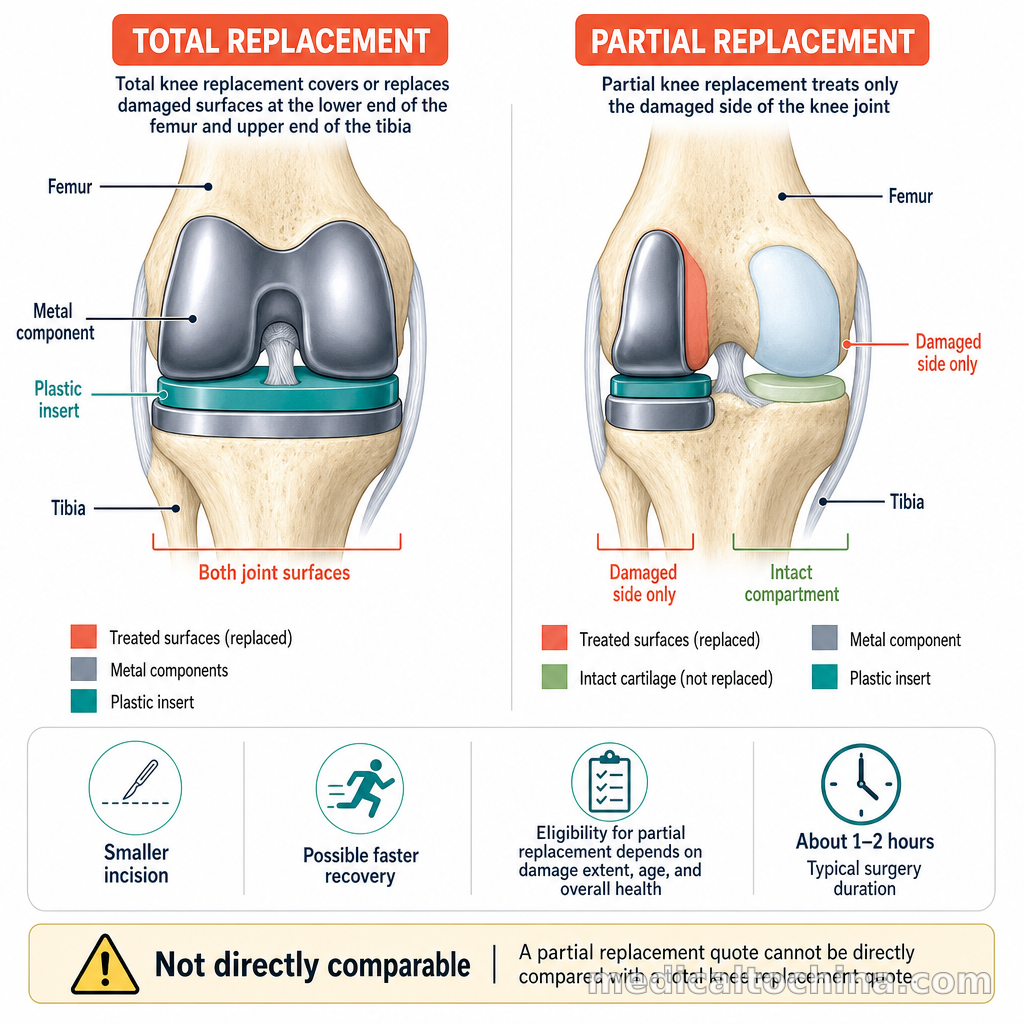
Total knee replacement and partial knee replacement are not the same procedure. Total knee replacement, the more common type, generally uses metal and plastic components to cover or replace damaged surfaces at the lower end of the femur and upper end of the tibia. Partial replacement treats only the damaged side of the knee. It usually involves a smaller incision and may offer faster recovery, but suitability depends on the extent of damage, age, and overall health.[Source 3]
The operation usually takes about 1–2 hours and may be performed under general anesthesia or regional spinal anesthesia.[Source 3] If one hospital is quoting for a partial replacement and another for a total knee replacement, the two price lists are not directly comparable.
Rather than publishing a broad country ranking, it is more useful to screen hospitals using five criteria:
- Whether the lead surgeon has experience in both primary replacement and complex or revision replacement;
- Whether the hospital’s accreditation, relevant case volume, and infection-control information can be verified;
- Whether the implant brand, specific model, and fixation method are included in the quote;
- Whether post-hospital rehabilitation, wound checks, and pre-departure assessment are comprehensive;
- Whether the total cost covers complication management and clinical handover after the patient returns home.
Wound closure should also be discussed during the preoperative consultation. Expert consensus indicates that wound closure after knee replacement affects postoperative rehabilitation. Barbed sutures may be used as an alternative to traditional sutures, while topical skin adhesives may replace some methods of skin-staple closure. However, these recommendations represent an interim consensus that needs to be updated periodically as new evidence emerges.[Source 2]
“Robot-assisted” surgery or “advanced implants” do not, by themselves, prove that a plan is more suitable. Commercial platforms promote robotic technology and specific implants as selling points, and a Lithuanian provider even lists robot-assisted surgery as a separate additional charge. Patients should ask the surgeon to explain how the technology would change the surgical plan for their specific case rather than relying on the label alone.[Source 5] [Source 9]
Patients from the United States, United Kingdom, Australia, United Arab Emirates, and Singapore should first have a local orthopedic surgeon confirm the diagnosis, fitness for travel, and likely type of surgery. Otherwise, an international comparison may simply be comparing different operations, lengths of hospital stay, and intensities of rehabilitation.
Destinations in China, Europe, and Asia: Costs Must Be Compared on the Same Basis
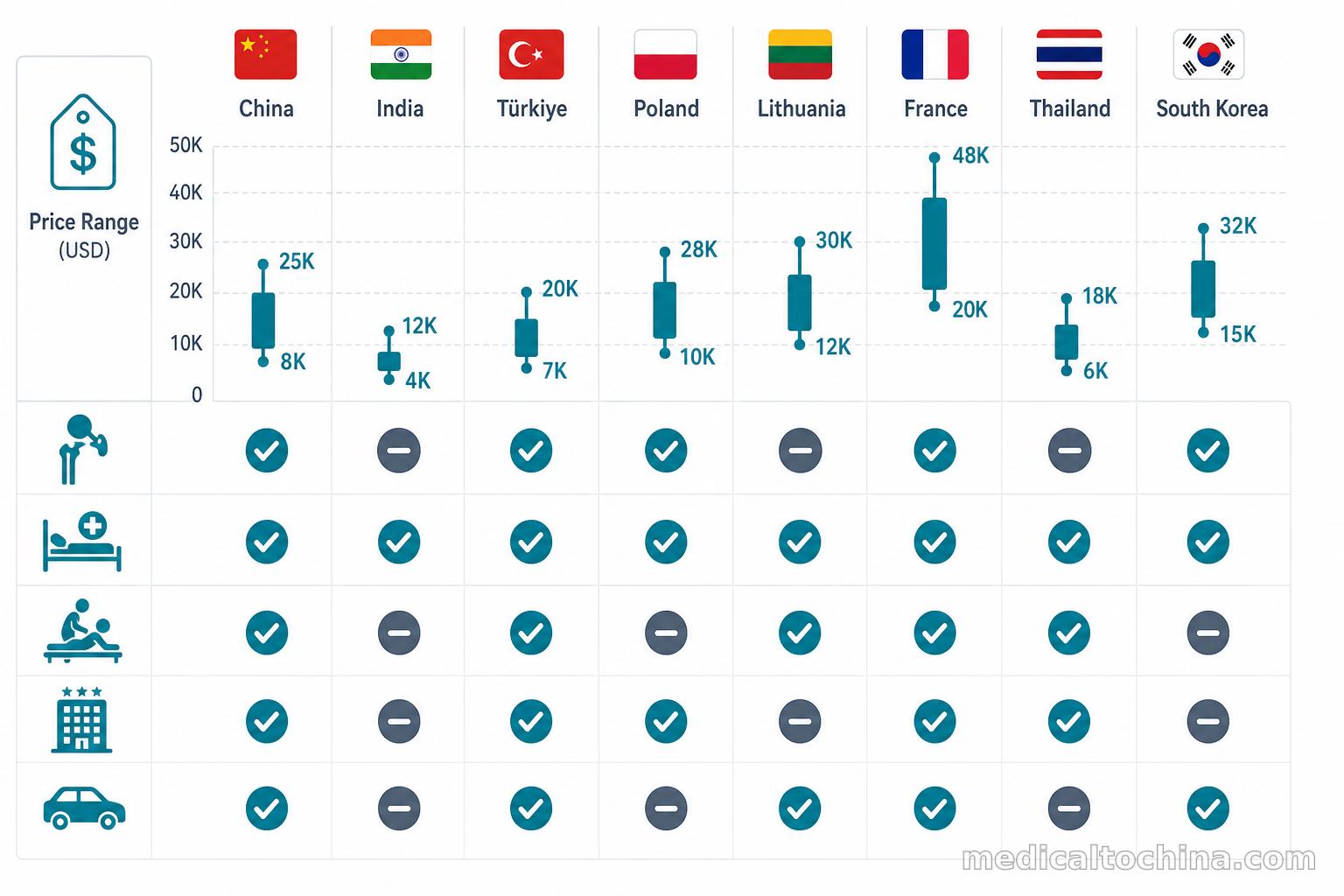
The China figures in the table below come from reference prices at high-level Chinese hospitals listed by medicaltochina.com. The final amount depends on the hospital’s formal quote after reviewing the patient’s imaging and medical history.[MTC] Most of the other figures come from commercial coordinators, aggregator platforms, or individual providers. They are industry estimates or package quotes, not standardized national prices.[Source 5] [Source 6] [Source 7] [Source 9] [Source 10] [Source 11]
| Destination | Reference range or package | Basis of quote | Source level |
|---|---|---|---|
| China | $4,200–14,000+ | Reference range for major procedures such as knee replacement; subject to a formal hospital quote | First-party reference data [MTC] |
| India | $5,000–9,000 | Industry estimate from a medical-travel coordinator | Commercial marketing [Source 11] |
| Turkey | $3,000–9,000; another estimate is £4,500–7,000 | Industry estimates from two commercial sources | Commercial marketing/unclassified [Source 5] [Source 7] |
| Poland | £5,500–8,000; 14-day inpatient packages from £10,290 | The former is an industry estimate; the latter includes an extended hospital stay and daily physiotherapy | Commercial, unclassified [Source 6] [Source 7] |
| Lithuania | From £7,370 | Surgery, implant, and 7 days of outpatient rehabilitation are priced separately; robot-assisted surgery costs an additional £2,085 | Commercial, unclassified [Source 9] |
| France | £12,490 | 15-day package including hospitalization, recovery accommodation, physiotherapy, transportation, and limited complication insurance | Commercial, unclassified [Source 10] |
| Thailand | $6,500–7,500 | Industry estimate from an aggregator platform | Commercial marketing [Source 5] |
| South Korea | $7,000–18,000 | Industry estimate from an aggregator platform | Commercial marketing [Source 5] |
As benchmark markets, medicaltochina.com reference data list a U.S. price of $19,000–68,000+ for major procedures such as knee replacement and a UK private-care reference price of $12,700–19,000.[MTC] Another commercial source aimed at UK patients gives an industry estimate of £12,000–18,000+ for private treatment, with complex cases potentially exceeding £20,000, but this is not an official standardized charge.[Source 7]
The table therefore cannot be used on its own to declare a “cheapest country.” Some prices cover only surgery and hospitalization, while others also include implants, local accommodation, transportation, or several days of rehabilitation. Bilateral replacement, complex deformity, revision surgery, additional imaging, and extended hospitalization can also change the total cost.[Source 6] [Source 9] [Source 10]
When evaluating Chinese hospitals, patients can begin with official hospital information. The Department of Orthopedic Surgery at West China Hospital, Sichuan University, states that it performs complex hip and knee replacements, revision procedures, and enhanced recovery orthopedic care, with more than 12,700 operations annually. This figure is the surgical volume for the entire orthopedic department, not knee replacement alone.[Source 12] medicaltochina.com reference materials state that most procedures can be arranged within one week of the patient’s arrival, although the specific date still depends on case assessment, bed availability, and preoperative testing.[MTC]
China’s practical barriers should also be included in the decision table. Patients should confirm English-language communication, medical-record translation, visa timing, payment methods, and rehabilitation handover after returning home. Decisions should not be based solely on price or the hospital’s overall size.[MTC]
For self-paying U.S. patients, the absolute price difference may be the primary factor. UK patients also need to compare the NHS pathway with private-care costs. Patients from Australia and Singapore should include long-haul flights and local rehabilitation expenses, while patients from the United Arab Emirates should compare treatment within the region with the convenience of cross-border travel.[Source 1] [MTC]
Breaking Down Quotes: Replace an Appealing Package Starting Price with the Total Landed Cost
Ask every hospital to provide a written quote using the same template, including at least:
- Surgeon, anesthesiologist, and operating-room fees;
- Implant brand, specific model, fixation method, and whether a patellar component is included;
- X-rays, MRI, blood tests, and anesthesia assessment;
- Expected length of hospitalization, room type, medications, and mobility aids;
- Number of physical therapy sessions during hospitalization and after discharge;
- Wound reviews, suture removal, or management of closure materials;
- Hotel or rehabilitation accommodation, companion costs, and local transfers;
- Interpretation, English-language medical records, and imaging files;
- Responsibility for complications, readmission, extended hospitalization, and revision surgery;
- Remote follow-up after returning home and handover to a local physician.
Actual packages best illustrate how similarly priced offers can include very different services. A Polish provider’s package starting at £10,290 includes 14 days of hospitalization, 24-hour medical care, and daily on-site physiotherapy, while accommodation for a companion costs extra.[Source 6] A Lithuanian provider lists surgery, the implant, and 7 days of outpatient rehabilitation separately, with an additional fee for robot-assisted surgery.[Source 9] A French package priced at £12,490 includes at least 3 nights in a private hospital, 10 nights in recovery accommodation, and at least 12 physiotherapy sessions, but complication insurance remains subject to specific terms.[Source 10]
China’s $4,200–14,000+ range should be treated as a reference for the screening stage, not a price commitment. The hospital must provide a final written estimate based on imaging, medical history, and the proposed surgical plan. CT or MRI, laboratory tests, companion care, interpretation, accommodation, and extended hospitalization should ideally be itemized separately.[MTC]
The following formula can be used:
Total landed cost = medical expenses + implant + post-hospital rehabilitation + flights and accommodation + companion costs + preoperative tests and postoperative physiotherapy in the home country + emergency budget for complications.
When comparing options, standardize the currency, type of surgery, room standard, length of hospitalization, and number of rehabilitation sessions. Before making payment, confirm the exchange rate, payment schedule, refund terms, and cancellation policy.[Source 6] [Source 9] [Source 10] [MTC]
The Greatest Risk May Arise After Discharge: Return Flights, Wounds, and Continuity of Rehabilitation
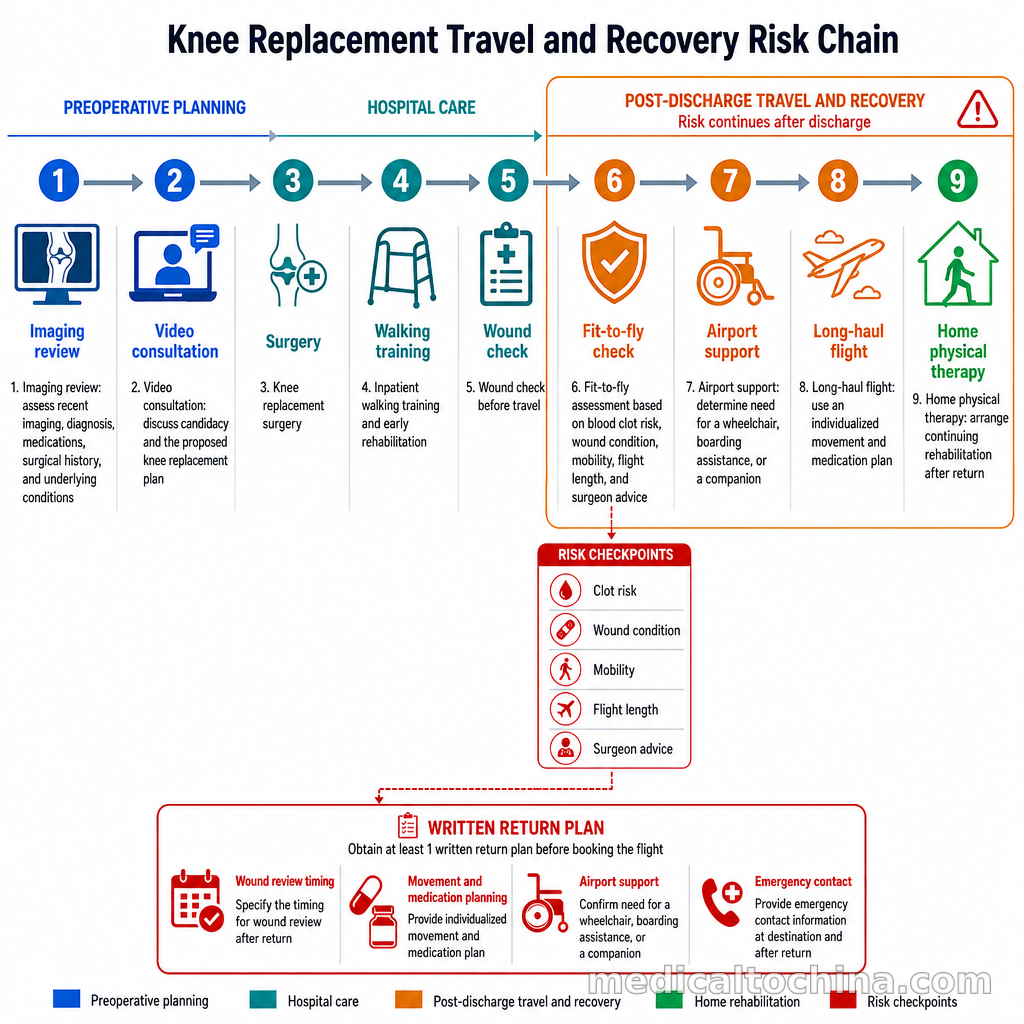
“Discharged from the hospital” does not mean “fit for a long-haul flight.” A peer-reviewed study found that there is currently no consensus on when patients may fly after hip or knee replacement and recommended that surgeons give advice on this issue cautiously.[Source 1]
For that reason, this article does not provide a universal waiting period without an individualized assessment. Return-travel arrangements should take into account the patient’s blood-clot risk, wound condition, mobility, flight duration, and the lead surgeon’s advice.[Source 1] Before booking tickets, obtain at least 1 written return-travel plan specifying:
- When the wound will be reviewed;
- When fitness to fly will be assessed;
- How activity and medication during the flight will be individualized;
- Whether an airport wheelchair, boarding assistance, or a companion is needed;
- Whom to contact if pain worsens or the wound shows abnormalities after returning home.[Source 1] [Source 2]
The quality of rehabilitation cannot be judged solely by the length of hospitalization. Some overseas packages include daily physiotherapy or 7 days of outpatient rehabilitation, but patients generally need to arrange and pay separately for ongoing physical therapy after returning home.[Source 6] [Source 7] [Source 9] At discharge, patients should obtain the operative report, implant labels, medication list, imaging records, and rehabilitation plan so that their home-country team can continue their care.[Source 9]
Do not shorten recovery time to make room for sightseeing. Early recovery after knee replacement still involves limited mobility, pain management, wound care, and cross-border travel, so the trip cannot be planned like a normal vacation.[Source 1] [Source 3]
For patients from the United States, Australia, and Singapore who need to fly between continents, the feasibility of the return trip may directly affect which destination is most suitable. Even if patients from the United Kingdom and United Arab Emirates face shorter flights, distance cannot replace an individualized medical assessment.[Source 1]
A Seven-Step Checklist Before Deciding: From Initial Imaging Review to Handover at Home
Following these 7 steps is more reliable than searching for an abstract “best country”:
- Organize clinical records. Obtain recent imaging, the diagnosis, a medication list, prior surgical history, and information on underlying conditions. Ask a local physician to determine whether replacement is needed and whether total or partial replacement may be appropriate.[Source 3]
- Create a shortlist. Select 2–3 countries and request at least one case-specific written opinion from a hospital in each country. Do not use advertised starting prices as the basis for the decision.[Source 5] [Source 7]
- Verify the team. Confirm the lead surgeon’s specialist qualifications and experience with primary and revision knee replacements, and verify the hospital’s ability to manage complex cases. For candidate hospitals in China, official information from West China Hospital may be consulted, but the individual lead surgeon must still be evaluated; overall departmental volume cannot substitute for personal experience.[Source 12]
- Hold a remote preoperative consultation. Ask why total or partial replacement is recommended, which implant brand and model will be used, the type of anesthesia, plans for wound closure and infection prevention, and the expected hospitalization and rehabilitation periods.[Source 2] [Source 3]
- Standardize the cost basis. Use the same table to compare medical services, implants, hospitalization, rehabilitation, accommodation, transportation, interpretation, and complication terms.[Source 6] [Source 9] [Source 10] [MTC]
- Set return-travel criteria before buying tickets. Ask the surgical team to explain the fitness-to-fly assessment process in writing because there is no single postoperative flight timeline suitable for every patient.[Source 1]
- Arrange handover after returning home. Find an orthopedic surgeon or physical therapist willing to provide follow-up care in advance, and confirm how the overseas hospital will transmit operative reports, implant information, and follow-up imaging.[Source 9]
If China is shortlisted, the next step is not to book a trip based on the reference range. It is to obtain an itemized written estimate from a Chinese hospital and compare it with other countries using the same type of surgery and cost categories. medicaltochina.com is a medical-concierge platform, not a hospital, and does not provide diagnoses. It can assist with matching patients to Chinese hospitals and specialists, arranging appointments and interpretation, coordinating visas and travel, and organizing hospital quotes into a format that makes item-by-item verification easier.[MTC]
Sources
- MTC. medicaltochina.com internal reference data: China cost reference and medical-concierge service scope.(First-party internal reference materials)
- Source 1. Oputa TJ, et al. Is There a Consensus on Air Travel Following Hip and Knee Arthroplasty? PMC.(Peer-reviewed journal)https://pmc.ncbi.nlm.nih.gov/articles/PMC10508977/
- Source 2. Maniar RN, et al. A STRIDE Initiative for Orthopedic Surgeons of India. PubMed.(Peer-reviewed journal)https://pubmed.ncbi.nlm.nih.gov/38009180/
- Source 3. NHS. How a knee replacement is done.(Government healthcare information)https://www.nhs.uk/tests-and-treatments/knee-replacement/how-its-done/
- Source 5. Bookimed. Where to Get the Best Knee Replacement Surgery Abroad.(Commercial medical-travel aggregator platform)https://us-uk.bookimed.com/article/the-best-knee-replacement-surgery/
- Source 6. EuroTreatMed. Knee Replacement Surgery Abroad in Poland.(Commercial provider, unclassified)https://eurotreatmed.co.uk/treatments/orthopaedics/total-knee-replacement/
- Source 7. Praga Medica. Cost of Knee Replacement Abroad Comparison.(Commercial source, unclassified)https://www.pragamedica.com/blog/news-orthopaedics/knee-replacement-abroad-cost
- Source 9. Nordorthopaedics. Knee Replacement Abroad in Lithuania.(Commercial provider, unclassified)https://www.nordorthopaedics.com/en/knee-replacement-surgery-abroad-lithuania
- Source 10. Elite Surgery Abroad. Knee Replacement Surgery Abroad: France.(Commercial provider, unclassified)https://www.elitesurgeryabroad.com/surgeries-uk/knee-replacement/
- Source 11. Emerge Medical Travel. Top 5 Countries for Knee Replacement Surgery in 2026.(Commercial medical-travel coordinator)https://emergemedicaltravel.com/blogs/top-countries-knee-replacement-surgery-2026/
- Source 12. West China Hospital, Sichuan University. Orthopedic Surgery.(Official hospital information)https://www.wchscu.cn/details/51686.html
Ready to start your health journey?
Our medical concierge team is available around the clock to answer your questions and help plan your treatment.