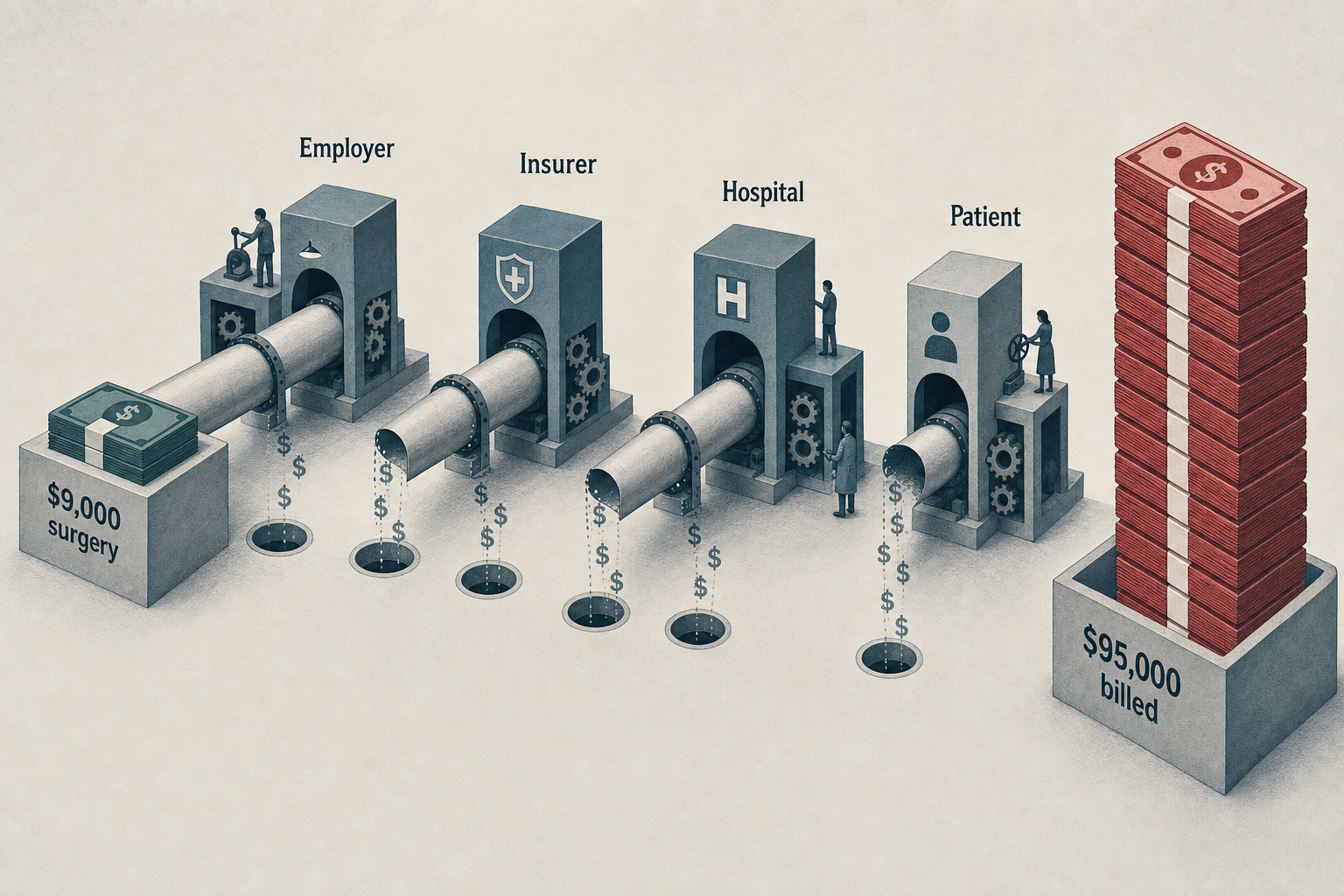


Yes—international health insurance can be used at hospitals in China, but the specific outcome depends on the insurance contract, treatment, hospital, and payment arrangements.
Among the 874 insurance products reviewed by medicaltochina.com, only 17 published complete public lists of hospitals in mainland China. Another 84 explicitly excluded mainland China, while 342 described their geographic coverage as worldwide without publishing a fixed list of Chinese hospitals. This database is provided for research purposes only and does not constitute a comprehensive survey of the international insurance market. [1]
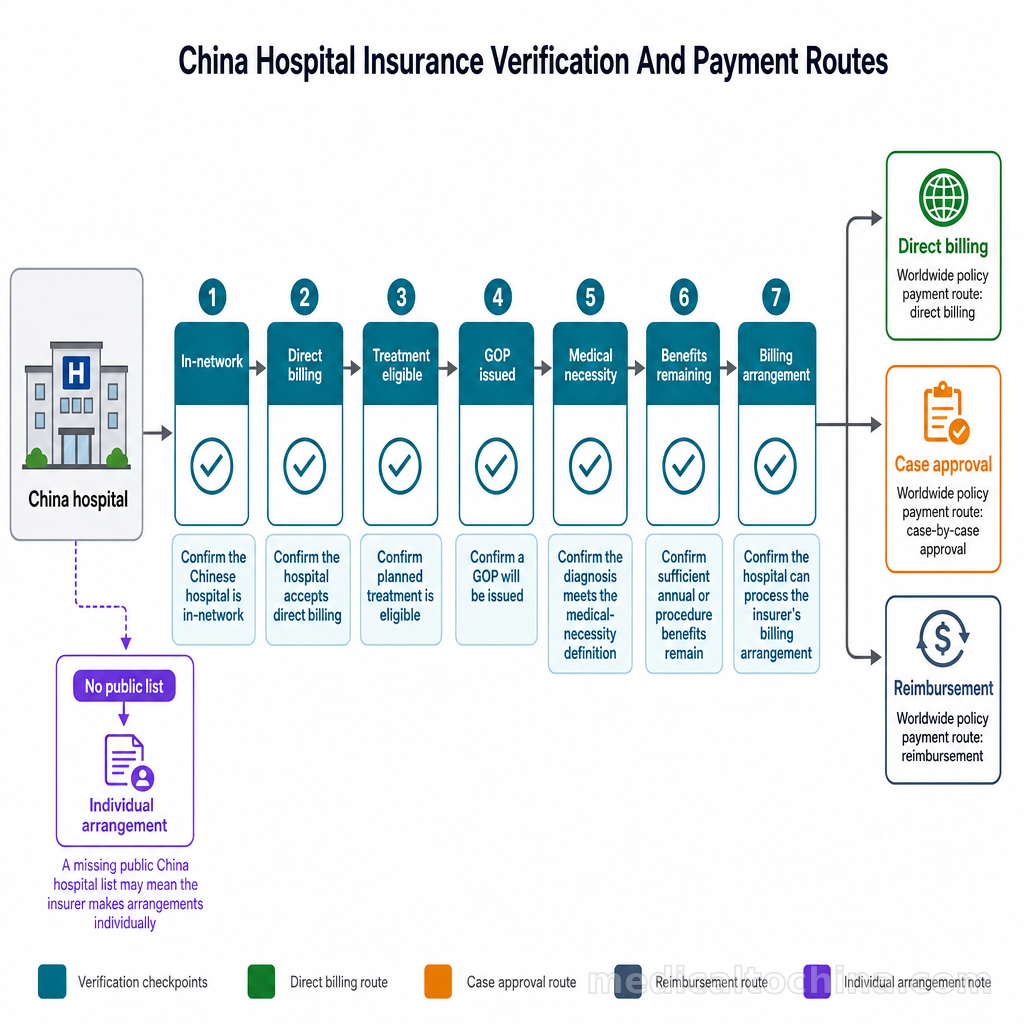
Therefore, “worldwide coverage” does not automatically mean that a patient can receive cashless treatment at any hospital in China. Policies may operate through one of three payment routes:
- Direct billing: The hospital and insurer have an established, approved billing arrangement.
- Case-by-case approval: The insurer confirms eligibility and issues preauthorization or a guarantee of payment (GOP).
- Reimbursement: The patient pays the hospital first and then submits a claim. [1]
Before traveling, patients should obtain written answers to three separate questions:
- Does this specific policy cover mainland China?
- Is the treatment planned at the designated hospital and department covered?
- Will the insurer pay the hospital directly, or must the patient pay upfront?
These questions must be resolved at the level of the specific policy, not simply by looking at the insurer’s brand. Insurance is issued by a particular legal entity under specific terms, and products sold in different countries may have different hospital partnership arrangements. [1]
For planning purposes, medicaltochina.com’s reference prices for leading hospitals in China indicate consultation fees of $7–28, CT or MRI scans per body part costing $42–280, and major surgery costing $4,200–14,000 or more. These are reference ranges, not guaranteed quotations; the final price is the written quotation issued by the hospital. [2]
Coverage Depends on the Specific Policy, Not the Insurer’s Brand
If a patient simply asks whether “Cigna,” “Bupa,” “Aetna,” or another insurer covers China, the question is not specific enough. What must actually be confirmed is whether the particular plan issued by the relevant underwriting entity covers the medical services the patient plans to receive in mainland China, and whether the hospital can use the payment method associated with that plan.
The research database recorded the following situations among the 874 products reviewed:
| Public evidence concerning coverage in China or payment arrangements | Number of products |
|---|---|
| Complete public list of hospitals in mainland China | 17 |
| Mainland China explicitly excluded | 84 |
| Worldwide coverage stated, but no fixed list of Chinese hospitals | 342 |
| Payment arranged case by case through preauthorization or GOP | 113 |
| Existing public evidence indicates reimbursement only | 94 |
| Partial or conditional hospital list | 80 |
| Network directory available only after member login | 59 |
| Payment method cannot be determined from existing public evidence | 85 |
These categories are not interchangeable. A worldwide policy without a public list of Chinese hospitals does not necessarily exclude coverage. It may require the insurer, claims administrator, and hospital to arrange payment separately for each admission. The situation is different when mainland China is explicitly excluded: if China is outside the geographic coverage area, the hospital’s willingness to treat the patient does not create insurance coverage. [1]
Policy terms usually determine:
- The geographic coverage area;
- Whether treatment must be medically necessary;
- Whether the planned treatment meets the coverage conditions;
- Exclusions for pre-existing conditions;
- Network rules for hospitals and healthcare providers;
- Preauthorization requirements;
- Annual, lifetime, per-treatment, room, or geographic limits;
- Deductibles, copayments, coinsurance, or other out-of-pocket costs; and
- Payment and claims procedures. [1]
A hospital may accept an international patient on a self-pay basis without being part of that patient’s insurance network. An insurer may cover China geographically without agreeing to pay a particular hospital directly. Patients need separate confirmation from both the hospital and the insurer.
International Health Insurance vs. Travel Medical Insurance
Standalone travel medical insurance is generally intended to cover sudden illness or accidental injury during a trip. Depending on the policy terms, it may cover emergency inpatient treatment, prescription medication, diagnostic services, or medical evacuation. However, this type of insurance is generally not designed to pay for a planned operation, routine monitoring, elective diagnostics, or treatment that was arranged before departure. [3]
International health insurance for expatriates, internationally mobile employees, or people living abroad for extended periods may provide broader outpatient, inpatient, diagnostic, and specialist coverage. Whether that coverage applies in China depends on the plan’s geographic coverage, exclusions, limits, and authorization rules. [1]
The distinction matters. If a traveler suddenly develops appendicitis in China, they may be able to claim emergency treatment under travel medical insurance. But if a patient specifically flies to China for a knee replacement that had already been recommended in their home country, the same type of insurance may exclude the admission because the treatment was planned before travel. [3]
Travel insurance may also exclude pre-existing conditions, epidemics, medical evacuation, or destinations affected by government travel warnings. The product name alone cannot answer these questions; the details of coverage and the policy terms must be reviewed. [3]
What “Worldwide Coverage” Means
“Worldwide coverage” usually describes the geographic scope of a policy, but it does not necessarily confirm:
- Whether a particular hospital in China is part of the insurance network;
- Whether the hospital accepts direct billing;
- Whether the planned treatment meets the coverage conditions;
- Whether a GOP will be issued;
- Whether the diagnosis meets the policy’s definition of medical necessity;
- Whether sufficient annual or per-treatment coverage remains; or
- Whether the hospital can process the insurer’s billing arrangements. [1]
Accordingly, a worldwide policy may operate through direct billing, case-by-case approval, or reimbursement. The absence of a public list of Chinese hospitals may mean that the insurer arranges care case by case rather than maintaining a publicly searchable network directory. [1]
Do Not Assume Your Home-Country Healthcare Arrangements Apply
Patients often assume that healthcare arrangements in their home country automatically extend overseas. Planned private healthcare in China generally must be handled under the terms of the individual’s insurance policy, rather than automatically receiving coverage through a national public healthcare or reciprocal healthcare arrangement. [4] [1]
United States. Patients should first establish whether their coverage is domestic employer-sponsored insurance, international health insurance, expatriate benefits, Medicare, Medicaid, or travel medical insurance. Commercial travel insurance guidance states that Medicare and Medicaid may provide little or no coverage outside the United States. Participation in any of these programs should not be treated as proof of coverage for planned treatment in China. [3]
United Kingdom. China is not included in the list of countries and territories covered by reciprocal healthcare agreements with non-EU countries published by the UK government. The UK government advises travelers to carry insurance that covers medical expenses. A GHIC or EHIC should not be treated as authorization for planned private treatment at a hospital in China. [4]
Australia, the United Arab Emirates, and Singapore. A familiar insurance brand name is not enough. Patients need to verify the legal entity issuing the insurance, the plan name, policy number, geographic coverage, and claims administrator. The medicaltochina.com directory includes plan-level research related to Australian Unity, Medibank, Zurich Australian Insurance, Sukoon, ADNIC, Orient Insurance UAE, AIA Singapore, HSBC Life Singapore, Raffles Health Insurance, and other companies. The directory does not establish that every plan offered by these companies covers every hospital or treatment in China. [5]
Confirm Coverage and Payment Arrangements Before Traveling
Patients should obtain written confirmation before scheduling treatment or traveling. A general statement that “international medical expenses are covered” does not establish that the planned diagnosis, treatment, hospital, department, and payment method have all been approved. [1]
> Written confirmation should identify the specific policy, mainland China coverage, diagnosis and treatment, designated hospital and department, treatment dates, coverage limits, deductibles or copayments, exclusions, preauthorization status, and payment method.
Patients should ask:
- Is mainland China within the geographic coverage area of the policy?
- Is treatment planned before travel covered?
- Have any pre-existing conditions been accepted for coverage?
- Does the designated hospital meet the conditions of this specific policy?
- Does the designated department or international patient department qualify?
- Are the attending physician or surgical team subject to network restrictions?
- Is preauthorization required?
- Will the insurer issue a GOP?
- Which treatments, dates, and monetary limits does the approval cover?
- What deductibles, copayments, coinsurance, or other out-of-pocket costs apply?
- Which devices, medications, services, or follow-up treatments are excluded?
- Will the insurer pay the hospital directly, or reimburse the patient?
- How should changes to the hospital quotation after admission be handled? [1]
Patients should also request an itemized quotation from the Chinese hospital for the planned treatment. Depending on the treatment, the quotation may list consultation, diagnostic testing, surgeon and anesthesiologist fees, operating room charges, implants or devices, room, nursing, laboratory services, medication, rehabilitation, and follow-up visits separately. The insurer’s written response should address the same items individually. [1]
Patients should retain the insurer’s responses, reference numbers, customer-service representative’s name, confirmation dates, and all emails or portal messages. If a third-party administrator is responsible for approval, patients should ask whether that administrator has authority to issue authorization documents and GOPs. [1]
Preauthorization and Guarantees of Payment
Preauthorization means that the insurer reviews the proposed treatment before it is provided. The review may confirm whether the patient meets the coverage requirements, whether the treatment is medically necessary, the approved hospital, the treatment dates, and the covered amount or scope. [1]
A guarantee of payment (GOP) is a written commitment from the insurer to the hospital to pay for specified treatment within specified limits. For planned inpatient care, a GOP usually applies to one specific admission rather than providing an unlimited promise for future treatment. [1]
The database shows that, among the 874 products reviewed, 113 arranged payment case by case through preauthorization or a GOP. This approach may be particularly important for policies that cover China but do not publish a fixed list of Chinese hospitals. [1]
A GOP issued for imaging does not necessarily mean that surgery has been approved. Authorization for outpatient treatment does not automatically equal authorization for inpatient care. If the diagnosis or treatment plan changes, the insurer may require additional review before paying for newly added services. [1]
Location May Affect the Payment Method
Based on the public evidence reviewed, direct-billing partnerships are concentrated mainly in China’s major cities. In the medicaltochina.com database, 29% of recorded network-hospital relationships were concentrated in Shanghai and Beijing, while the eight cities with the highest numbers accounted for approximately half of the verified hospital relationships. These figures summarize partnerships recorded in the database; they do not guarantee applicability to any particular policyholder and do not represent a complete national hospital network. [1]
| City | Aggregate number of hospital partnerships |
|---|---|
| Shanghai | 1,693 |
| Beijing | 1,426 |
| Guangzhou | 562 |
| Shenzhen | 401 |
| Hangzhou | 303 |
| Chongqing | 256 |
| Tianjin | 254 |
| Chengdu | 252 |
The database records insurer partnerships in 163 cities in China. If the hospital where a patient plans to receive care is outside the eight cities listed above, the patient should prepare to pay first and claim later unless written confirmation of direct billing has already been obtained. [1]
The same principle applies in Shanghai, Beijing, Guangzhou, and other major cities. The appearance of a city in the database does not prove that a particular hospital, department, or treatment accepts the patient’s specific insurance plan.
Confirm the Hospital’s Arrangements
The hospital’s international patient office or finance department should confirm:
- Whether it accepts the insurer or claims administrator;
- Whether the designated department participates in the arrangement;
- Whether a GOP is required;
- To whom the GOP should be sent;
- Which costs the patient must pay personally;
- How additional treatment will be handled; and
- Whether the quotation applies to the planned admission date. [6] [1]
Even if a hospital cannot process direct billing for a particular insurer, it may still accept an international patient on a self-pay basis. Conversely, an insurer may confirm that China is within the geographic coverage area but require the patient to pay first and seek reimbursement because no direct-billing arrangement exists. [1]
Direct Billing Is Possible, but the Correct Hospital Partnership Must Be in Place
Direct billing, sometimes called cashless treatment, means that the hospital submits authorized charges to the insurer or its claims administrator. The patient may still have to pay deductibles, copayments, excluded items, or costs exceeding the authorized limit. [1]
A Beijing municipal government guide states that international patients with high-end commercial health insurance can use direct billing when the insurer and healthcare institution have established a direct-billing partnership. Patients may present their insurance card and passport for identity verification. The hospital and insurer then settle covered medical expenses without requiring the patient to pay those expenses in advance. [6]
The guide lists MSH China, Ping An, AIA, Cigna & CMB, Allianz Partners, and other insurers that commonly participate in direct-billing partnerships. At the same time, it requires patients to check the list of insurers with which the specific medical institution has signed an agreement. [6]
This guide does not establish that all hospitals, cities, insurers, insurance plans, or departments in China support direct billing. The hospital’s current list of partners and the authorization issued for the patient’s specific policy remain decisive. [6]
What Patients Need at Admission
Under the direct-billing process described in the Beijing guide, patients must present their insurance card and passport for identity verification. These documents can establish the policyholder’s identity, but they do not by themselves prove that the planned admission has been approved. The hospital may still require valid preauthorization or a GOP before treatment begins. [6] [1]
Before arriving at the hospital, patients should send the international department:
- Proof of insurance or an insurance card;
- Passport details;
- The preauthorization reference number;
- The GOP, if one has been issued;
- The hospital’s itemized quotation; and
- The billing contact at the insurer or claims administrator. [6] [1]
The hospital should confirm that it accepts this specific arrangement and explain the amount the patient must pay personally. Patients should not assume that the hospital can resolve outstanding, unapproved inpatient charges after treatment has begun. [1]
Treatment Costs in China: Planning References
The following are reference prices for leading hospitals in China from medicaltochina.com. These are planning ranges, not guaranteed quotations. Final prices depend on the hospital, diagnosis, treatment plan, room type, devices, medication, and complexity of treatment. [2]
| Service | China reference price | U.S. reference price |
|---|---|---|
| Consultation or registration | $7–28 | $100–300 |
| Routine laboratory tests | $14–70 | $25–125 |
| CT or MRI, per body part | $42–280 | $400–7,000 |
| Outpatient procedure or minor surgery | $7–70 | $100–500 |
| Major surgery, such as knee replacement | $4,200–14,000+ | $19,000–68,000+ |
For patients arranging treatment in China, lower hospital prices may reduce the amount of money that must be raised in advance, but they do not change the insurance analysis. The insurer may exclude a procedure, apply coverage limits, require a deductible, or provide reimbursement rather than direct billing. The hospital quotation and the insurer’s written decision should be compared item by item. [1] [2]
If Direct Billing Is Unavailable, Plan for Reimbursement
Reimbursement may still allow treatment to proceed, but it increases the patient’s cash-flow risk. With direct billing, the hospital and insurer settle authorized charges. Under a reimbursement model, the patient pays the hospital first and then submits a claim for the covered portion. [1]
Based on the available public evidence, the database classified 94 of the 874 products reviewed as supporting reimbursement only. This does not mean that all other products automatically provide direct billing: some use hybrid arrangements, member-only networks, or case-by-case approval. [1]
If the patient’s location is outside the largest network cities, they should prepare to pay first and claim later unless the insurer and hospital have confirmed another payment method in writing. The same preparation is appropriate even in a major city if a GOP has not yet been issued. [1]
Documents and Claims Preparation
Before making payment, patients should request written instructions from the insurer’s claims department confirming:
- The required invoices, receipts, medical records, prescriptions, diagnostic reports, and discharge documents;
- The claims deadline;
- The submission channel;
- Translation or certification requirements;
- The exchange-rate date and conversion method;
- Deductibles, copayments, excluded services, and non-medical travel expenses; and
- Whether the hospital quotation can be reviewed in advance before treatment. [1]
Patients should retain itemized invoices, official receipts, proof of payment, diagnostic reports, operative reports where applicable, discharge summaries, prescriptions, medical records, the hospital quotation, preauthorization documents, the GOP, and correspondence with the insurer and hospital. [1]
Patients should ask the insurer to estimate the amount likely to be required upfront and explain the portion expected to be paid personally. “100% coverage” may still be subject to an annual deductible, a room limit, excluded implants, a per-treatment cap, or a medical-necessity review. [1]
If the hospital quotation changes, patients should obtain the insurer’s approval before the additional treatment is provided whenever circumstances permit. A reimbursement decision made only after treatment may not cover an unapproved procedure or device. [1]
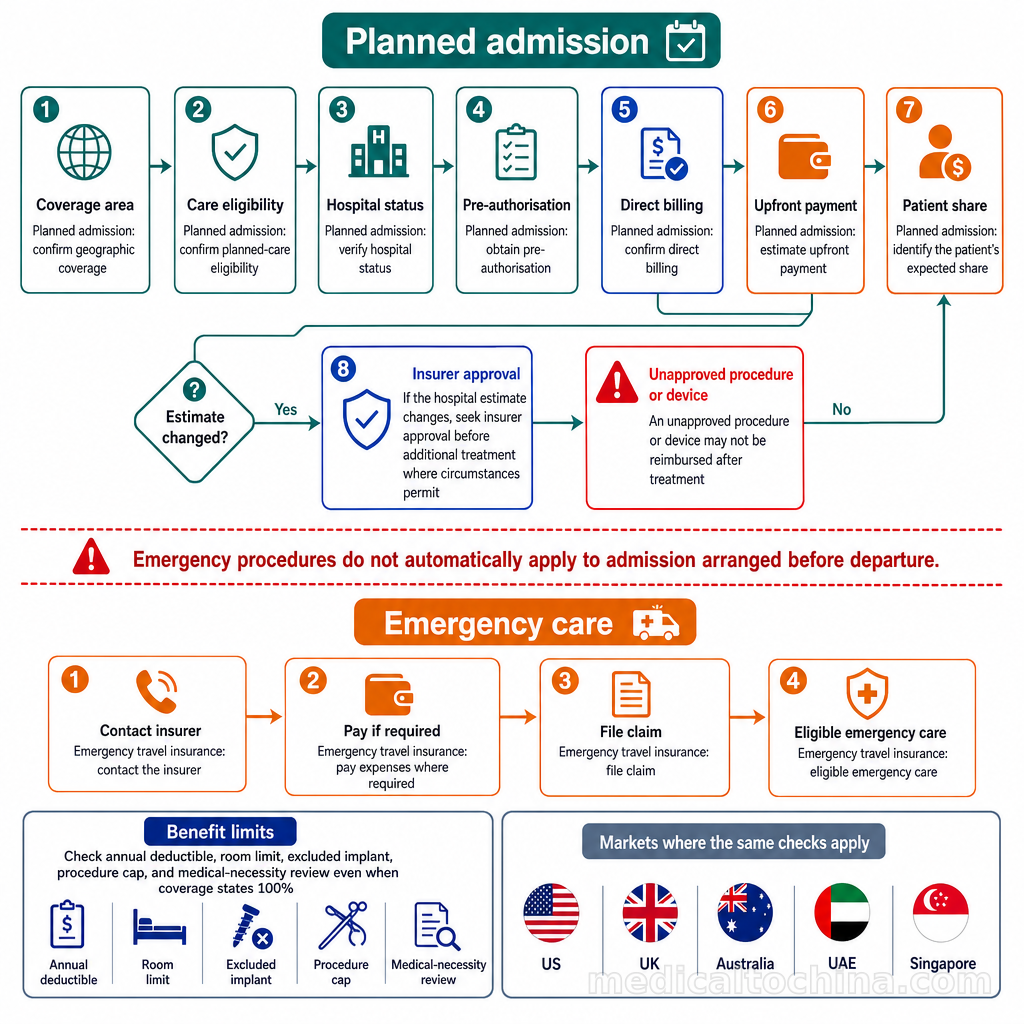
Emergency travel insurance follows a different process. Travel medical insurance guidance generally advises patients to contact the insurer, pay expenses upfront when necessary, and then submit a claim for eligible emergency medical services. Patients should not assume that the same process applies to a planned admission arranged before departure. [3]
What Patients from the United States, United Kingdom, Australia, the UAE, and Singapore Should Confirm Next
Across these five markets, the decisive questions are broadly the same: geographic coverage, the distinction between eligibility for planned and emergency treatment, hospital status, preauthorization, direct billing, coverage limits, and personal expenses. Because domestic healthcare and insurance systems cannot substitute for one another, patients in each country begin with different assumptions. [4] [1] [3]
| Patient’s market | Questions to ask the insurer |
|---|---|
| United States | Does mainland China cover planned treatment, or only emergencies that occur unexpectedly? Is the policy domestic, international, employer-sponsored, or travel medical insurance? Do Medicare or Medicaid apply? Is the hospital in network, and can it issue a GOP? [3] [1] |
| United Kingdom | Is the proposed care planned private treatment rather than treatment under a reciprocal national healthcare arrangement? Does the private policy cover mainland China? Have pre-existing conditions been accepted? Is medical repatriation covered separately? [4] [1] |
| Australia | Is China covered under the international insurance policy, or only under travel insurance products? Which legal entity and claims administrator handle approval? Can the designated hospital accept direct billing? If reimbursement is required, how much must the patient pay upfront? [5] [1] |
| United Arab Emirates | Does the policy cover mainland China? Is approval handled by the insurer or a third-party claims administrator? Can that entity issue a GOP for the designated hospital and treatment? Which deductibles, copayments, exclusions, and annual limits apply? [5] [1] |
| Singapore | Does the plan cover the designated Chinese hospital and its international patient department? Can the hospital accept direct billing under the plan? Do consultation, diagnostic testing, admission, surgery, and follow-up care require preauthorization? [6] [1] |
The medicaltochina.com directory includes plan-level research related to Aetna International, Cigna Global, UnitedHealthcare Global, Aviva UK, Bupa Global, Medibank, Australian Unity, Zurich Australian Insurance, ADNIC, Sukoon, Orient Insurance UAE, AIA Singapore, HSBC Life Singapore, Raffles Health Insurance, Great Eastern Singapore, and other companies. These are examples of researched plan series and do not mean that every product issued by these companies has received unconditional approval. [5]
Patients’ written inquiries should identify the Chinese hospital, department, diagnosis, proposed treatment, estimated cost, and planned dates. Specific questions tied to the actual admission arrangements are more useful than a general question such as “Do you cover China?” [1]
Compare the Hospital Quotation with the Insurance Decision Item by Item
The most practical approach is to place the Chinese hospital’s itemized quotation alongside the insurer’s written decision and compare them line by line.
| Item on the hospital quotation | What the insurer should confirm |
|---|---|
| Consultation and diagnostic testing | Whether covered, applicable limits, and authorization |
| Room | Room limit and the patient’s out-of-pocket share |
| Surgery or treatment | Approved treatment and monetary limit |
| Surgeon and anesthesiologist fees | Whether included or subject to a separate limit |
| Medication, laboratory tests, and devices | Applicable conditions, exclusions, and prior approval |
| Rehabilitation and follow-up visits | Coverage period, location, and limits |
| Translation, transportation, and accommodation | Whether covered; do not assume reimbursement |
| Deductibles and copayments | Specific amount or calculation method |
A hospital quotation is not a promise of payment by the insurer. Insurance approval also does not necessarily prove that the hospital will accept direct billing. The admission, treatment, hospital, dates, and payment method in the two documents should match. [6] [1]
If the insurer responds that coverage is available, the patient should obtain:
- The policy reference number;
- The geographic coverage area;
- The approved diagnosis and treatment;
- The designated hospital and department;
- The authorization reference number;
- The GOP, if applicable;
- The authorized monetary limit;
- The validity dates;
- Deductibles, copayments, and exclusions; and
- Billing contacts at the hospital and insurer. [1]
The hospital should then confirm that it can accept the arrangement. If the insurer states that it supports “reimbursement only,” the patient should verify before traveling the expected amount of the bill that must be paid upfront, the claims deadline, submission channel, currency rules, document requirements, and expected personal expenses. [1]
Practical Conclusion
International health insurance can be used at hospitals in China, but whether it can be used in practice depends on the specific policy, treatment, hospital, and payment arrangements—not the insurer’s brand name.
The research evidence explains why a policy labeled “worldwide coverage” still requires confirmation at the hospital level: among the 874 products reviewed, only 17 published complete public lists of Chinese hospitals, 84 excluded mainland China, and 342 used worldwide-coverage language without a fixed list of Chinese hospitals. [1]
The safest process is to:
- Confirm the specific policy and the legal entity that issued it;
- Confirm coverage in mainland China;
- Confirm that the planned treatment meets the coverage conditions;
- Verify the hospital and department;
- Obtain preauthorization;
- Request a GOP if direct billing is needed;
- Obtain an itemized quotation from the hospital;
- Compare the quotation with the insurer’s written decision;
- Prepare financially for reimbursement if direct billing has not been confirmed; and
- Retain all authorization documents, invoices, receipts, and correspondence. [6] [1]
For patients comparing treatment locations, medicaltochina.com’s reference prices show that, at leading hospitals in China, consultation and registration cost $7–28, routine laboratory tests cost $14–70, CT or MRI scans cost $42–280 per body part, and major surgery costs $4,200–14,000 or more. These are reference ranges, not guaranteed quotations; the final price is the quotation issued by the target hospital. [2]
The practical next step is to request an itemized quotation from the Chinese hospital and ask the insurer to issue a written decision addressing the same items. medicaltochina.com can assist with obtaining and translating hospital quotations, but it is a medical concierge service platform, not a hospital, insurer, or insurance adviser, and it does not provide payment or treatment guarantees. [2]
References
- Pinned source — medicaltochina.com
- medicaltochina.com price and service reference data — medicaltochina.com
- How travel medical insurance works — nerdwallet.com
- Reciprocal healthcare agreements between the UK and non-EU countries — gov.uk
- Pinned source — medicaltochina.com
- Convenient payment methods—Beijing—People’s Government of Beijing Municipality — english.beijing.gov.cn