


There is no single “best country in the world” for every cancer patient. Cancer Research UK’s report on an International Cancer Benchmarking Partnership study described a comparison involving more than 780,000 patients across three continents. It found substantial differences among countries in chemotherapy and radiotherapy use and the time taken to start treatment. For stage Ⅲ colon cancer, for example, 5-year net survival was 70.7% in Norway, 70.1% in Australia, and 63.3% in the UK. [1]
What This Article Covers
- Why country rankings alone cannot identify the “best country in the world for cancer treatment”
- What the available evidence shows—and does not show—about the United States, the UK, Australia, Germany, Singapore, the UAE, and China
- How to create a personal shortlist based on cancer type, stage, treatment technology, waiting times, and total costs
- How to recognize misleading comparisons involving survival rates, hospital rankings, and claims made by medical travel agencies
- What written information international patients should request from hospitals before traveling abroad for treatment
There Is No Single “Best Country for Cancer Treatment” for Every Patient
Cancer is not one disease but a large group of diseases that vary substantially in where they arise, how they behave biologically, and how they are treated. WHO states that cancer treatment generally includes surgery, radiotherapy, and systemic therapy. Many cancers can be cured when detected early and treated effectively. [2]
Destination selection must therefore account for the cancer type, stage, pathological subtype, molecular characteristics, previous treatment, coexisting conditions, and performance status. A patient who needs complex surgery, precision radiotherapy, CAR-T therapy, or routine postoperative adjuvant treatment will face a very different shortlist.
At least the following 3 levels must be distinguished:
- A country’s overall cancer survival outcomes;
- A particular hospital’s experience in treating a specific cancer type and stage;
- The expected benefits and risks of a particular treatment plan for an individual patient.
International outcome studies do show differences among countries, but comparisons must first be adjusted for patient characteristics, the distribution of cancer types, and differences between healthcare systems. National survival data cannot be translated directly into an outcome guarantee from a particular hospital for an individual patient. [3]
For patients from the United States, the UK, Australia, the UAE, and Singapore, the first step is not to rank countries. It is to define the clinical question that needs to be answered: confirming the diagnosis, seeking complex surgery, assessing proton or carbon-ion therapy, determining eligibility for CAR-T, or obtaining an independent second opinion. China has capabilities including proton therapy, carbon-ion therapy, robotic surgery, and approved CAR-T products, but the availability of a technology does not mean that a patient meets the indications for it. [2][4]
How the Available Evidence Assesses Major Candidate Countries
The available information does not support an overall country ranking covering every cancer type. The most specific evidence compares particular cancer types and stages over defined periods. Other countries frequently appear on medical tourism websites, but comparable outcome data are lacking.
| Country or region | What the available information shows | Main limitations | Type of source |
|---|---|---|---|
| Australia | In ICBP-related research, chemotherapy and radiotherapy started relatively quickly; 5-year net survival for stage Ⅲ colon cancer was 70.1% | Findings cannot be extrapolated to every cancer type, hospital, or year | News report from a research organization |
| Norway | Treatment started relatively quickly in the same comparison; 5-year net survival for stage Ⅲ colon cancer was 70.7% | Does not represent actual access for international patients | News report from a research organization |
| UK | In the jurisdictions and period covered by the report, chemotherapy and radiotherapy use was lower and waits to start treatment were longer | Insufficient to conclude that all UK cancer services perform poorly | News report from a research organization |
| United States | Commercial information identifies MD Anderson as a specialist center providing targeted therapy, immunotherapy, and complex surgery | No direct comparison with other countries using costs and outcomes standardized by the same cancer type, stage, and age | Commercial source |
| Germany | Medical tourism sources frequently list it as a destination for cancer treatment | Information mainly comes from industry or institutional promotion and cannot support an independent national ranking | Commercial source |
| Singapore and the UAE | Commercial rankings list international oncology programs in Singapore and Dubai | Authoritative comparative data on outcomes for specific cancers, waiting times, and total costs for international patients are lacking | Commercial source |
| China | Proton therapy, carbon-ion therapy, robotic surgery, and CAR-T are available; reference information states that most treatments can be arranged within one week of arrival | Eligibility must be verified; language, visas, and cross-border follow-up must also be addressed | First-party reference data |
The data for Australia, Norway, and the UK come from Cancer Research UK’s report on the ICBP study. The study included eight cancers—esophageal, stomach, colon, rectal, liver, pancreatic, lung, and ovarian cancer—diagnosed from 2012—2017. Its findings cannot be used to predict outcomes for other cancers or the current performance of a particular hospital. [1]
For the United States, commercial descriptions of MD Anderson’s treatment capabilities can help identify a candidate center, but they do not prove that the United States is “number one in the world” for every patient. [5] Germany, Singapore, and Dubai also frequently appear in rankings published by medical tourism companies or clinics. However, publishers may use their own partner networks and assessment methods, so their conclusions should be treated as promotional leads rather than independently verified rankings. [5][6][7]
China has more than 100 JCI-accredited hospitals and offers the cancer treatment technologies described above. International patients should still verify the specific center, clinical team, indications, and treatment schedule. Language barriers may arise outside a hospital’s international department, while visa arrangements and continuity of prescriptions after returning home must also be planned in advance. [4]
The practical implications are straightforward: Australian patients may not need to travel abroad; UK patients may place greater emphasis on waiting times; self-paying patients from the United States often need to compare total costs carefully; and patients from Singapore and the UAE should compare their local options item by item with written opinions from specialist centers abroad rather than making decisions based on online rankings. [1]
Use Five Criteria Instead of Copying a “World’s Best” Ranking
1. Comparable Outcomes for the Same Cancer Type and Stage
Ask the hospital to specify the cancer type, pathological subtype, stage, age range, treatment regimen, statistical period, and follow-up duration covered by its data. An “overall cancer survival rate” cannot answer an individual patient’s question.
International data are also influenced by screening coverage, stage at diagnosis, population age, and case mix. Comparisons must be standardized before they can be interpreted cautiously. [3]
2. Genuine Access to Multidisciplinary Care and the Required Technology
Confirm whether the hospital can provide pathology and imaging reviews, as well as a joint assessment by surgical, radiation oncology, and systemic therapy teams. The surgery, radiotherapy, and systemic therapies identified by WHO generally need to be combined according to the cancer type and disease status, rather than ranked by how new the technology is. [2]
If considering China, ask whether proton therapy, carbon-ion therapy, robotic surgery, or CAR-T is appropriate for the specific diagnosis, which center would provide it, and what the standard alternatives are. A list of available equipment is not, by itself, a treatment recommendation. [4]
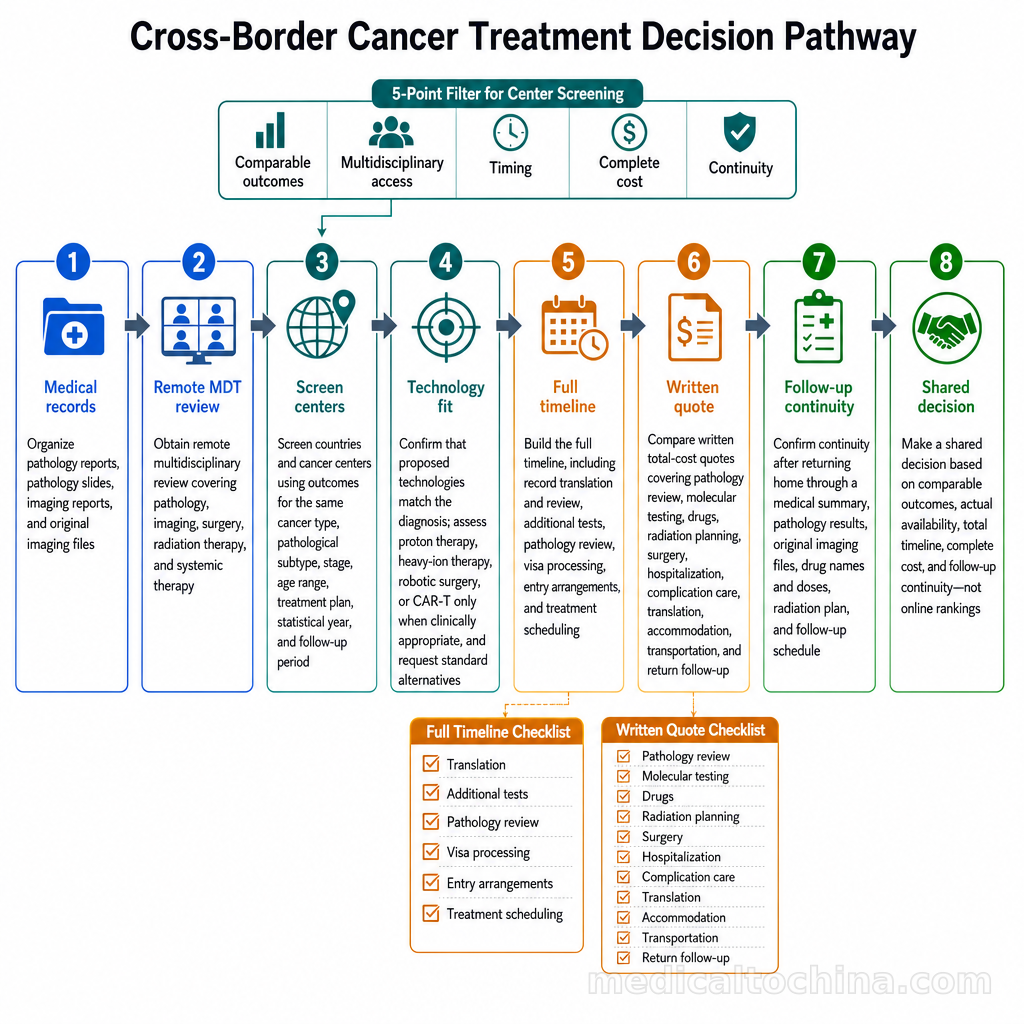
3. Time From Medical Record Submission to Actual Treatment
Cancer Research UK’s report specifically notes that aggressive cancers such as ovarian, lung, and pancreatic cancer require prompt diagnosis and treatment, while countries differ in waiting times and patterns of treatment use. [1]
A realistic timeline should include translation and review of medical records, additional tests, pathology review, visa processing, entry arrangements, and treatment scheduling. Asking only how many days it takes to begin treatment after arriving at the hospital overlooks delays that occur beforehand.
4. Total Costs, Not a Quote for a Single Treatment Course
medicaltochina.com’s reference pricing for top-tier Chinese hospitals shows that the reference price for a CT or MRI scan in China is 42—280 US dollars per body area, compared with 400—7,000 US dollars in the United States. The reference price for an outpatient consultation or registration in China is 7—28 US dollars. These ranges are for preliminary screening only; final costs depend on the hospital’s written quotation. [4]
This price list does not break down the full cost of cancer treatment by cancer type, drug, dose, and treatment course. It therefore cannot support claims that treatment for a particular cancer will save a fixed amount. A quotation should list pathology review, molecular testing, medications, radiotherapy planning, surgery, hospitalization, complication management, interpretation, accommodation, transportation, and follow-up examinations after returning home.
5. Continuity of Care After Returning Home
The overseas center should provide a medical summary, pathology results, original imaging files, medication names and doses, radiotherapy plans, and follow-up arrangements in a form that the patient’s doctors at home can use. Cancer treatment often combines several modalities, so cross-border care should not cover only the overseas treatment phase while neglecting subsequent care. [2]
Three Myths About High Survival Rates, Hospital Rankings, and the “Latest Treatments”
Myth 1: The Country With the Highest Survival Rate Offers the Highest Personal Chance of Success
National survival rates reflect early screening, stage at diagnosis, population characteristics, risk factors, and access to healthcare. They can be used to compare healthcare systems but cannot be converted directly into an individual prognosis. [3][2]
Similarly, data on stage Ⅲ colon cancer cannot predict outcomes for advanced lung cancer, pancreatic cancer, or hematologic malignancies. Comparisons among Australia, Norway, and the UK can only be interpreted within the populations, cancer types, stages, and years included in the original study. [1]
Myth 2: Global Hospital Rankings Provide an Objective Answer
Hospital rankings may incorporate research output, clinical trials, size, patient capacity, or cost-effectiveness, but these measures do not necessarily reflect how well a hospital’s care fits an international patient’s needs. [7]
Different commercial sources describe Germany, the United States, South Korea, India, Turkey, Dubai, and Singapore as leading destinations, but their lists do not agree. This inconsistency shows that definitions of “best” may be influenced by assessment methods and commercial partner networks. [5][6][7]
Myth 3: If the Latest Technology Is Available, It Should Be Used
The shared assumption behind these 3 myths is that population-level data, institutional reputation, or access to technology can serve as an individual treatment conclusion.
Innovative therapies may be limited by indications, regulatory requirements, and clinical trial eligibility criteria. Research and clinical trial capabilities do not mean that a patient should bypass standard treatment. [7] China’s capabilities in proton therapy, carbon-ion therapy, and CAR-T likewise do not prove that every cancer patient will benefit. Before deciding, patients need a specialist opinion based on their complete medical records and should ask the doctor to explain the standard treatment, innovative options, and the risks of not receiving treatment. [4]
Any conclusion about the “best country” should specify the applicable cancer type, stage, patient population, data year, evidence source, and limitations. A ranking that omits this information is suitable only as a starting point for identifying candidate centers. [3][6]
Next Step: Send the Same Medical Records to 2–3 Centers for Comparable Plans
First, create a standardized medical record package and send exactly the same information to 2–3 centers:
- The pathology report and whether the slides or paraffin blocks can be obtained;
- CT, MRI, and PET reports, together with the original DICOM files;
- Clinical stage and molecular or genetic test results;
- Records of surgery, chemotherapy, radiotherapy, targeted therapy, and immunotherapy;
- Current medications, allergies, coexisting conditions, and performance status;
- The key questions that the local treating physician wants the second opinion to address.
Then ask each hospital to answer the following in writing: whether repeat pathological diagnosis or additional testing is needed; whether the treatment goal is cure, reducing the risk of recurrence, or disease control; why the proposed plan is recommended; what standard alternatives are available; how long it will take from medical record review to treatment initiation; how much experience the team has treating patients with the same cancer type and stage; whether a clinical trial is involved and what its eligibility criteria are; what the quotation includes and excludes; how complications, disease progression, or inability to proceed as planned would be handled; and who will oversee follow-up care and prescription continuity after the patient returns home.
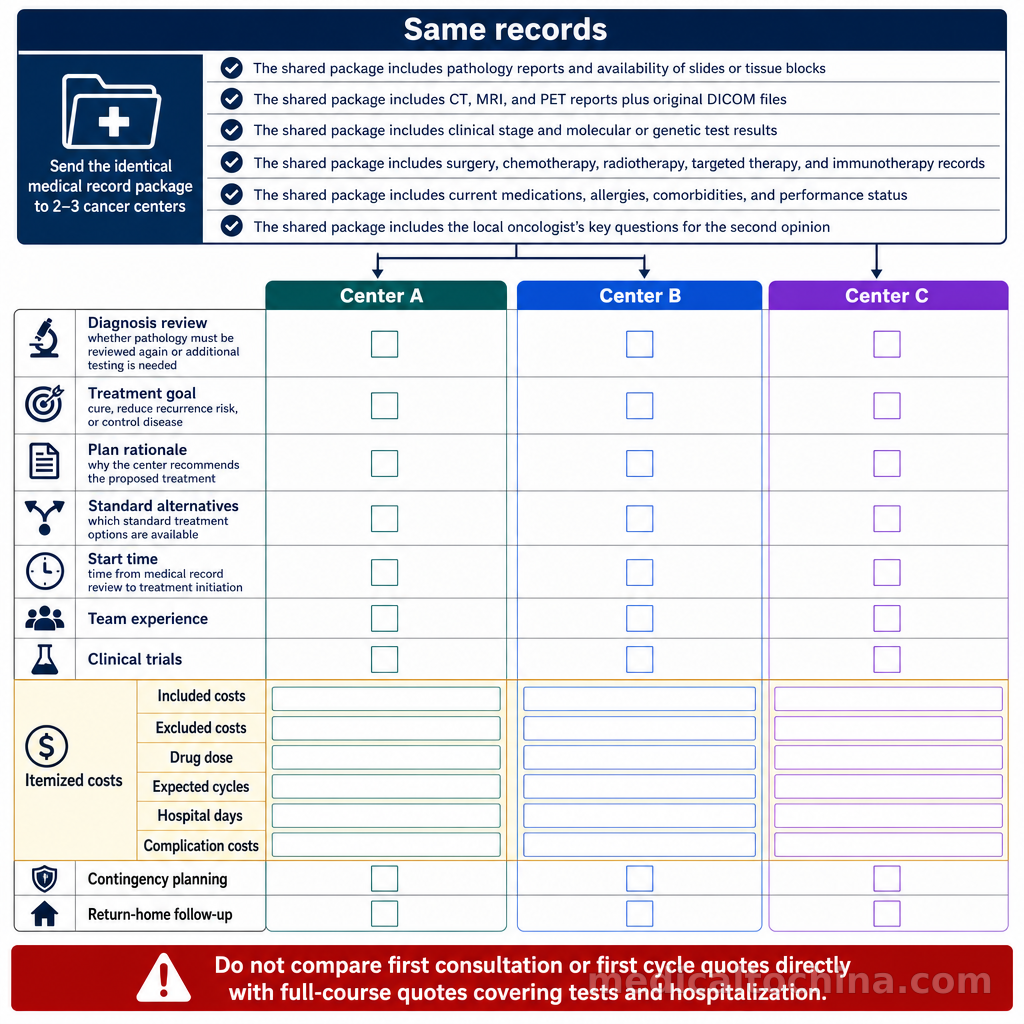
Quotations must use the same scope. A figure covering only the initial consultation or first treatment course cannot be compared directly with a quote that includes tests, hospitalization, and the complete treatment course. Drug doses, expected number of cycles, length of hospitalization, and costs related to complications particularly need to be itemized. [4]
If China is shortlisted, the next step is to obtain a written, itemized estimate from a Chinese hospital and confirm the international patient department, English-language medical documentation, interpretation arrangements, visa timeline, and follow-up after returning home. medicaltochina.com can assist with matching patients to Chinese hospitals and specialists, appointments, interpretation, and travel coordination. However, the platform is not a hospital, does not provide medical diagnoses, and does not guarantee costs or treatment outcomes. [4]
The final decision should be made jointly by the patient and an oncology specialist who has access to the complete clinical picture. An overseas second opinion can provide additional evidence for decision-making, but it should not delay urgent or ongoing treatment that is already clearly indicated. [2]
References
- How does UK cancer treatment measure up to other countries? — news.cancerresearchuk.org
- Cancer — who.int
- Global comparison of cancer outcomes: standardization and ... — pmc.ncbi.nlm.nih.gov
- medicaltochina.com pricing & services reference data — medicaltochina.com
- Cancer Treatment Abroad — bookinghealth.com
- 15 Best Cancer Treatment Hospitals in The World 2026 — my1health.com
- Which is the Worldwide's Best Cancer Hospital? — hallwang-clinic.com